Most people who try to learn programming get stuck in the same trap. They learn some syntax, follow a few tutorials, and can dutifully copy code from a video. But when they sit down with a blank screen to build their own idea, they freeze. The problem is that they’ve learned how to type, but not how to think. They know the ingredients, but have no idea how to write a recipe.
That’s a common failure mode in technical education. We focus so much on the specifics—the syntax of JavaScript, the methods of a library—that we forget to teach the most important thing: how to break a complex problem down into a system of smaller, simpler problems. And then, how to build those small systems and connect them.
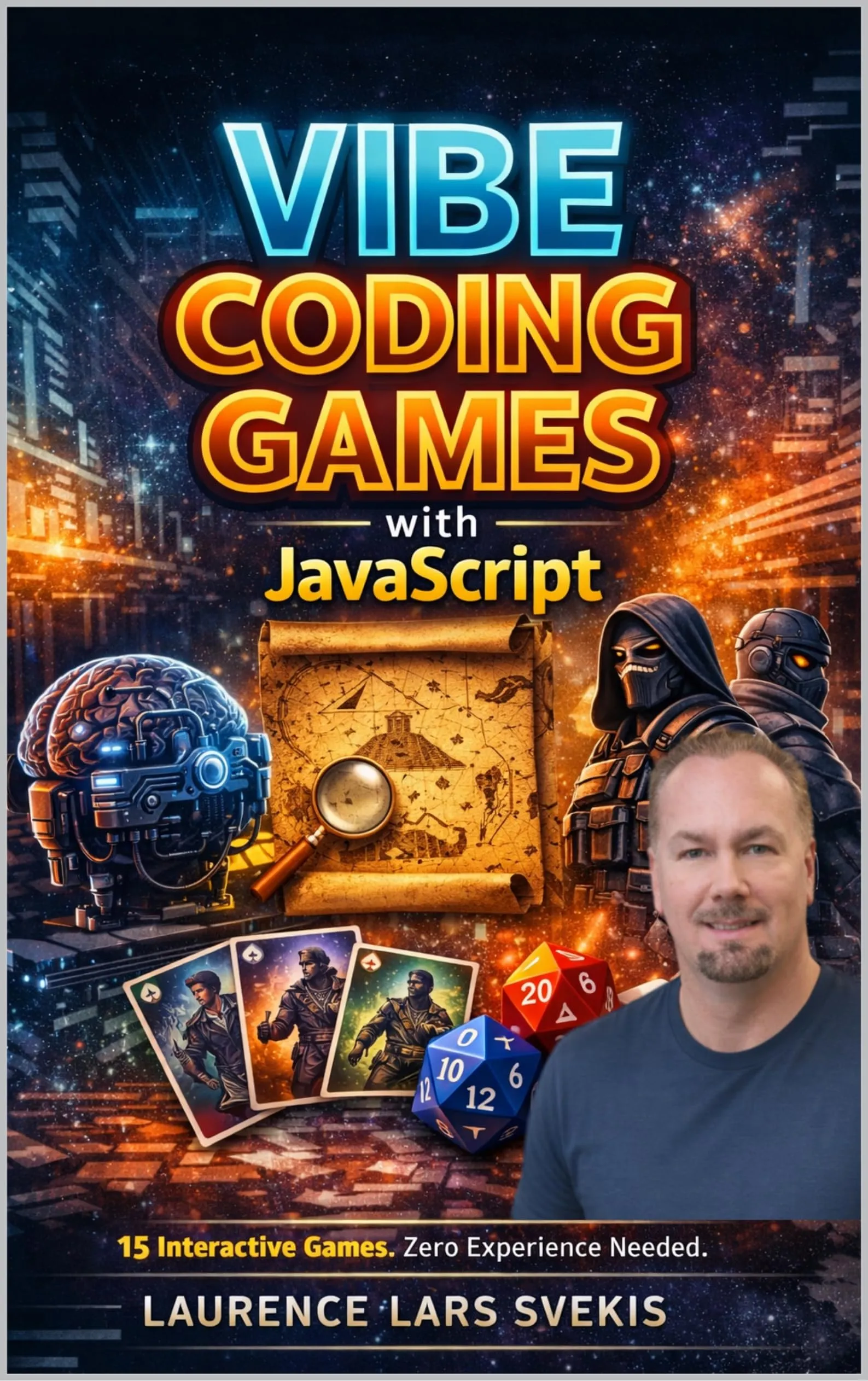
A new book seems to be trying to fix this. It’s called Vibe Coding Games with JavaScript, but the “vibe” isn’t about just hacking things together. It’s about getting a feel for the underlying architecture of a program. It proposes a shift in your thinking, from asking how do I code this? to asking what system do I need to build?
That shift is everything.
Thinking in Systems, Not in Syntax
The book’s approach is to teach you how to think like a developer by building a series of games. And not just as fun little exercises. Each game is a vehicle for learning a core programming system:
- A slot machine isn’t just a game; it is a lesson in managing state and randomness.
- Blackjack becomes a study in turn-based logic.
- Poker forces you to think about pattern recognition.
- Real-time games teach you about game loops, movement, and collision detection.
You don’t just build 15 games. You build 15 systems. You start to see that most complex applications are just different combinations of these fundamental systems: state management, rule engines, rendering loops, and user input. Once you understand the systems, the specific code becomes much easier. You’re no longer staring at a blank page, but mapping out a blueprint.
Using AI as a Tool, Not a Crutch
That is where it gets really interesting. The book tackles the thing everyone is wondering about: AI. The common fear is that using AI to code will make you a worse programmer. And if you just ask it to “write me a game,” that’s probably true. You are outsourcing the thinking.
The approach here is different. It teaches you to use AI as an assistant, a partner in the design process. It’s not about telling the AI what to build, but using it to explore the systems you need. You learn how to write effective prompts, not to get the final code, but to help you brainstorm, debug, and refactor. You’re still the architect; the AI is your brilliant but literal-minded intern. You have to guide it. Doing this effectively is a skill, and it’s probably going to be one of the most valuable skills a developer can have in the next decade.
Who Should Try This?
If you are a complete beginner, this looks like a way to skip months of frustration. Instead of just memorizing what `Array.prototype.map` does, you’ll be using it to build a system, and you’ll understand *why* it exists. You’ll be building real things from the start, which is the best way to stay motivated.
If you’re a developer who already knows some JavaScript but feels stuck in a framework rut, this could be like a refreshing trip back to first principles. Game development is the classic “shop class” for programmers. It forces you to get your hands dirty with the fundamentals of state, loops, and performance. You’ll think more deeply about how software actually works.
It seems the goal here isn’t to teach you JavaScript or to teach you game development. The goal is to teach you a method of thinking that will allow you to build anything. The games are just the practice field.