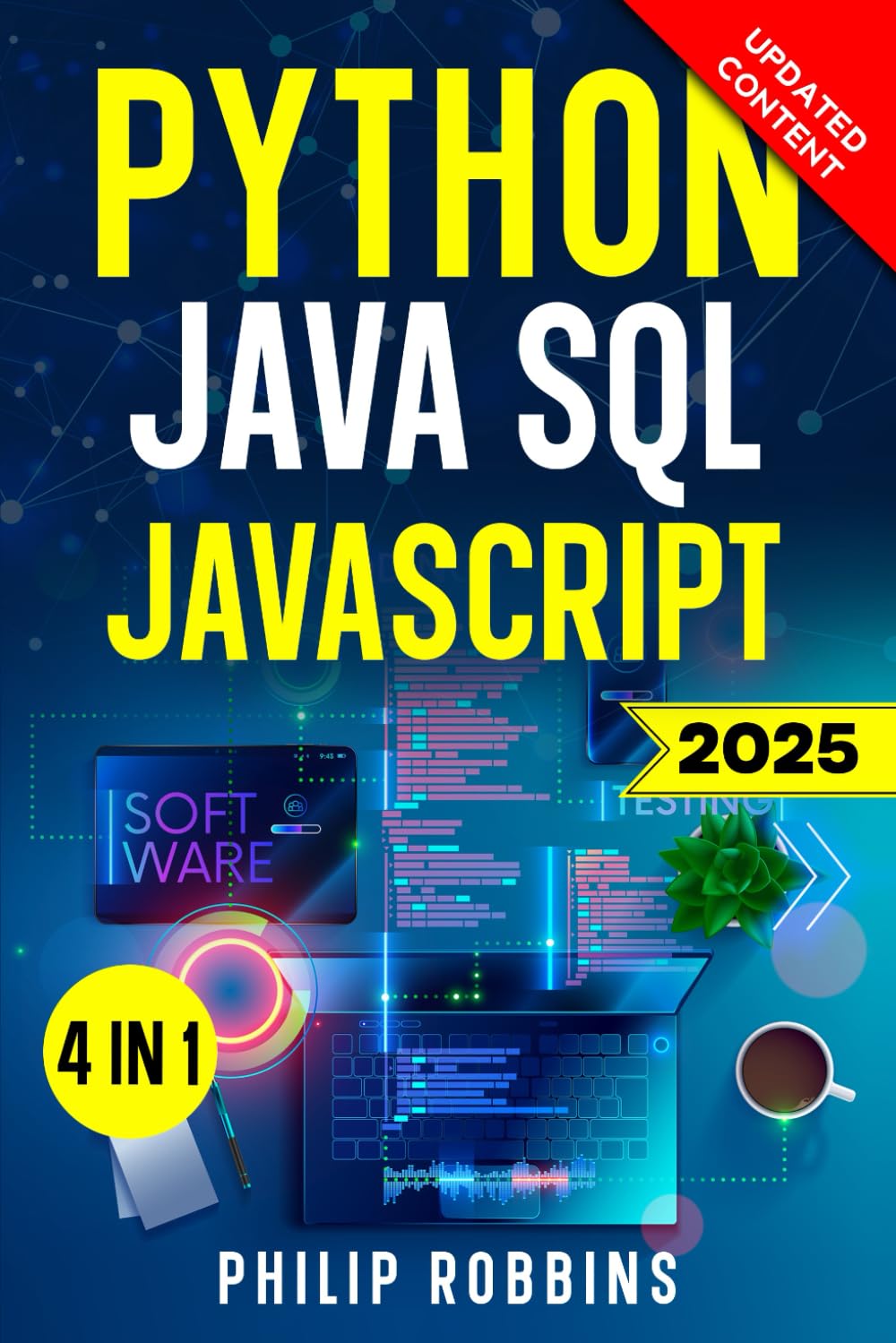
Let’s be clear about the premise of a book like this. The title promises mastery of four distinct, complex programming languages in a single “ultimate crash course.” In professional software development, we learn that such promises warrant a healthy dose of skepticism. Becoming a master of a single language is a multi-year endeavor involving thousands of hours of focused practice. The idea of mastering four—including the fundamentally different paradigms of procedural scripting (Python), object-oriented enterprise development (Java), declarative database querying (SQL), and event-driven web programming (JavaScript)—in 378 pages is, to put it mildly, unrealistic.
Think of it this way: this isn’t a blueprint for building a career; it’s a brochure for different kinds of construction materials. It will show you what wood, steel, concrete, and glass look like, but it won’t teach you how to frame a house, weld a beam, pour a foundation, or install a window.
A Question of Depth
The core challenge here is one of depth versus breadth. With roughly 95 pages dedicated to each topic, you are getting a high-level survey. You will likely learn the basic syntax for variable declaration, loops, and conditional statements in each language. You might build a “Hello, World!” application or a very simple command-line calculator. This is not a criticism of the content itself, but an attempt to manage expectations. This book is a survey, not a
study guide. It provides exposure, not expertise.
So, Who Is This book For?
Despite the title’s overreach, the book does have a valid, practical purpose for a specific kind of reader. You might find the book useful if you fall into one of these categories:
- The Undecided Beginner: You’ve heard you should “learn to code,” but you have no idea what the difference is between Python, Java, and JavaScript. This book will give you a quick taste of each, helping you decide which one feels more natural to you and which you’d like to pursue for a deep dive.
- The Adjacent Professional: You are a project manager, a UI/UX designer, a technical recruiter, or a QA analyst. You don’t need to write production code, but you need to communicate effectively with developers. Understanding the basic vocabulary and concepts of these languages can make you more effective in your role.
- The Curious Hobbyist: You have no professional aspirations but are simply interested in what programming is all about. This serves as a low-commitment tour of the modern programming landscape.
A More Effective Approach to Professional Development
If your goal aligns with the book’s subtitle—to “Stand Out from the Crowd and Find High-Paying Jobs”—then you must treat this book as, at best, a starting point. A more robust, effective, and professionally-oriented path would look something like this:
- Step 1: Choose One Language. Use this book (or online resources) to spend a day with each language. Pick the one that you find most interesting or that aligns best with the type of job you want (e.g., Python for data science, JavaScript for web development).
- Step 2: Go for Depth, Not Breadth. Put the book aside and acquire a comprehensive, highly-regarded book that focuses only on that one language. Look for texts that are 600+ pages long and come from reputable technical publishers. This is where you’ll find the necessary detail.
- Step 3: Write Code. A Lot of It. Reading is passive. Learning to code is an active, often frustrating, process of building things. Start with small command-line tools, then work your way up to a larger personal project. That is the single most important activity for developing real skill.
- Step 4: Discover the Foundations. Once you have a handle on a language, your next step isn’t to learn another language. It is to learn the timeless principles of software engineering: data structures, algorithms, and design patterns. This foundational knowledge is what truly separates a professional from a hobbyist and is what gets tested in serious technical interviews.
Using the book as a map to choose a destination is a sound strategy. Trying to use it as the vehicle to get you there, however, will leave you stranded far from your goal.