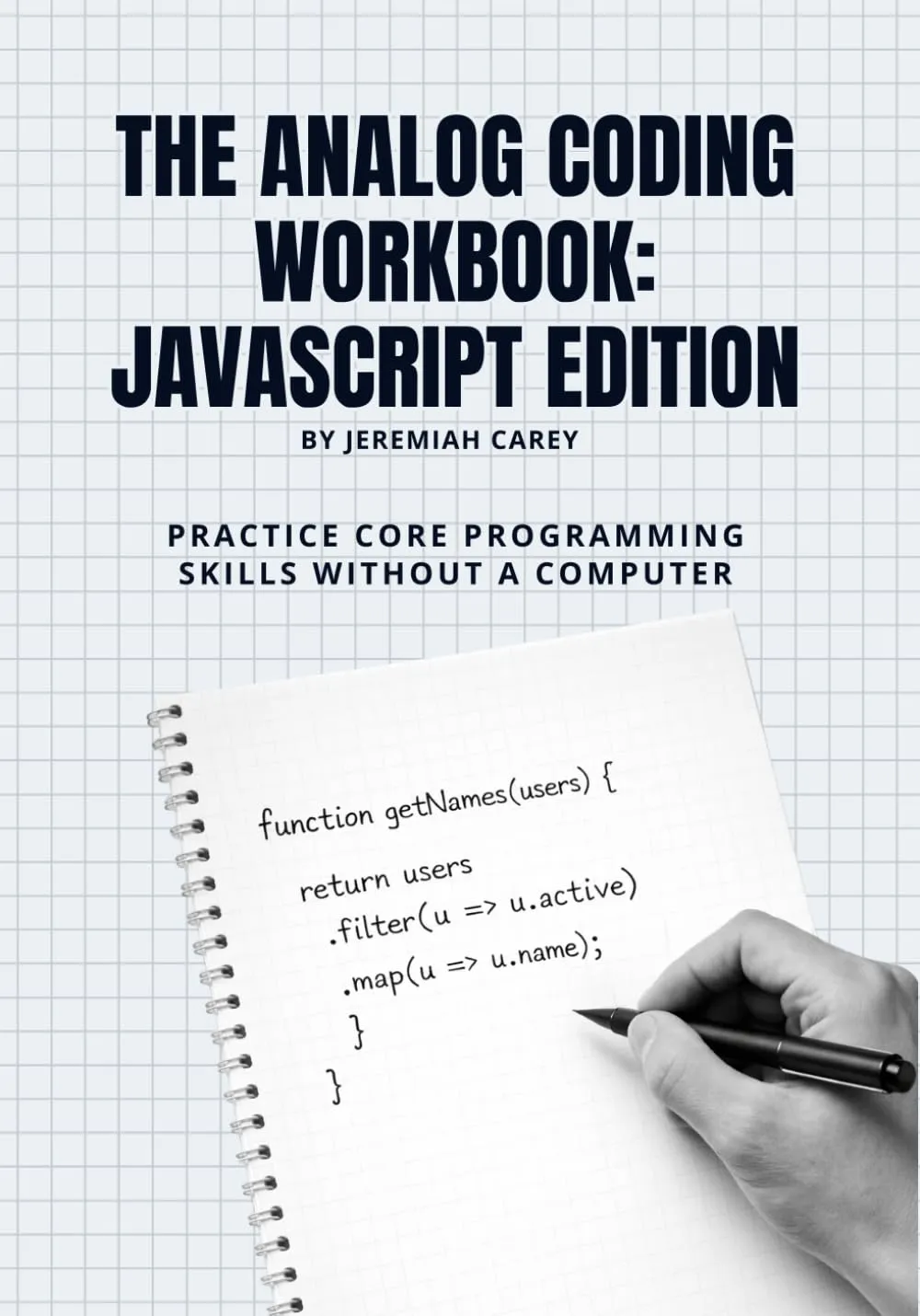
It might seem a bit anachronistic, right? A workbook for a field that’s entirely digital. We have sophisticated IDEs with code completion, powerful debuggers, and linters that catch our mistakes before we even think to run the code. So, the concept of picking up a pen to write JavaScript can feel like learning to drive a car by studying a horse and buggy.
But this is missing the point entirely. The value here isn’t in creating a functional, runnable artifact on paper. The value is in the friction. It is in the deliberate, slow-paced process of thinking through every single character you write down.
So, what’s a developer doing with a pen?
When you’re typing in an editor, it is far too easy to let the tools do the heavy lifting. You type half a function name, hit tab, and your brain never has to fully dredge up the precise syntax. You write a loop, the linter immediately highlights a missing brace, and you fix it reactively rather than proactively. This creates a shallow, temporary kind of knowledge.
Writing it out by hand forces a different kind of mental engagement. You have to internalize the syntax completely. You become the compiler. You have to trace the state of variables in your head, line by line, because there’s no debugger to do it for you. This workbook is structured around that very principle of deliberate practice. It’s not about writing volumes of code; it’s about meticulously thinking through small, foundational problems.
Who is this actually for?
Based on this approach, I can see this being exceptionally useful for a few specific groups of people. It’s not for everyone, mind you, but if you fit one of these profiles, this could be a genuine turning point in your learning.
- The absolute beginner. If you are just starting and the syntax feels like an alien language, that is for you. The physical act of writing `function`, `const`, and `let`, of placing every single curly brace and semicolon yourself, will build muscle memory far faster than typing and backspacing ever could.
- The developer stuck in “tutorial hell.” You’ve watched dozens of hours of videos and followed along, yet when faced with a blank file, you freeze. This workbook breaks that passive cycle. It forces you to produce, not just consume, and to confront the gaps in your own understanding without the safety net of a video to guide you.
- The self-taught developer who feels “shaky” on the fundamentals. Perhaps you’ve been working for a bit, patching things together from Stack Overflow, but you know you don’t have a solid grasp on closures, scope, or `this`. Going back to basics with this kind of focused, offline exercise can solidify those core concepts in a way that simply reading another article cannot.
Let’s be clear about what this isn’t.
That’s not a reference manual. You won’t find an exhaustive guide to the DOM API or deep dives into asynchronous patterns here. Its page count alone should tell you that. It is a workbook in the truest sense: a tool for practice and reinforcement. It’s the equivalent of a musician practicing scales or an athlete running drills. It’s the foundational work that makes the more complex, creative work possible.
If you are an experienced an JavaScript developer, that is obviously not for you. But if you’re trying to build that initial mental model of how the language truly works, disconnecting from the digital noise and engaging with the code in this tactile way might just be the most pragmatic and effective step you could take.