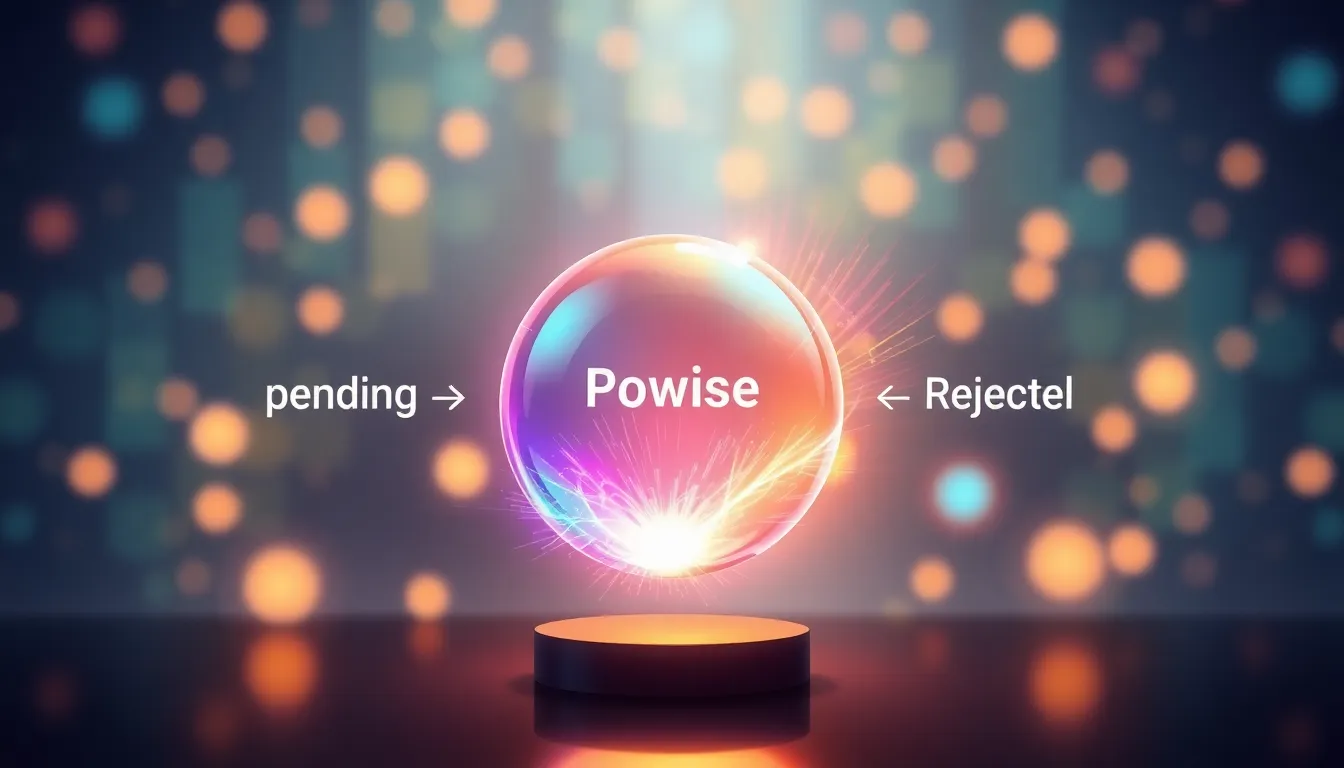
The promise lifecycle can be thought of as a sequence of states that a promise moves through from creation until it settles. When you create a promise, it starts in the pending state – neither fulfilled nor rejected. This state is essentially a placeholder, waiting for the asynchronous operation to complete.
Once the operation completes successfully, the promise transitions to the fulfilled state. At this point, the value it carries becomes available to any handlers attached via .then(). Conversely, if something goes wrong, the promise enters the rejected state, carrying an error or reason for the failure. This rejection can be caught downstream with .catch().
It is important to remember that a promise’s state is immutable once settled: you can’t go back to pending or switch from fulfilled to rejected. This immutability ensures predictable flows when chaining promises.
Handlers attached to a promise are queued and executed asynchronously, even if the promise has already been settled by the time the handler is registered. This behavior aligns with the microtask queue in JavaScript’s event loop, which defers execution until the current call stack is empty but before rendering.
Consider this example:
const promise = new Promise((resolve, reject) => {
  setTimeout(() => resolve("Done"), 1000);
});

promise.then(value => {
  console.log(value); // Logs "Done" after 1 second
});
Here, the promise stays pending for one second until the setTimeout fires and calls resolve. Only then does the attached then handler run. If the promise had been rejected instead, the catch handler would be invoked.
Promises provide a mechanism to chain asynchronous operations and handle errors gracefully. Each then returns a new promise, enabling sequences of asynchronous tasks. If a handler returns a value, that becomes the fulfillment value for the next promise. If it throws an error or returns a rejected promise, the chain jumps to the nearest rejection handler.
Here’s a quick illustration:
Promise.resolve(42)
  .then(value => {
    console.log(value); // 42
    return value * 2;
  })
  .then(value => {
    console.log(value); // 84
    throw new Error("Something went wrong");
  })
  .catch(error => {
    console.error(error.message); // "Something went wrong"
  });
The lifecycle of a promise – from pending, to fulfilled or rejected, then finally settled – forms the backbone of all asynchronous programming patterns in JavaScript. You’ll find that understanding this lifecycle in detail helps demystify the sometimes confusing behavior of chained promises and error propagation.
Next, when dealing with cleanup or finalization logic regardless of fulfillment or rejection, the finally method becomes a useful tool to integrate seamlessly into that lifecycle without disrupting the chain’s state or value.

TOCOL for iPhone 17 Pro Max Screen Protector/iPhone 16 Pro Max Screen Protector 6.9-Inch Instant Installation Tempered Glass HD Clear Full Coverage Protection Case Friendly 2 Pack
$9.49 (as of July 19, 2026 03:41 GMT +00:00 - More infoProduct prices and availability are accurate as of the date/time indicated and are subject to change. Any price and availability information displayed on [relevant Amazon Site(s), as applicable] at the time of purchase will apply to the purchase of this product.)Implementing finally in asynchronous workflows
The finally method is a powerful addition to the promise API, introduced in ES2018, that allows you to execute a piece of code after the promise has settled, regardless of its outcome. This can be particularly useful for cleanup tasks or finalization logic that should run irrespective of whether the promise was fulfilled or rejected.
When you attach a finally handler, it does not receive any arguments, and it does not affect the promise’s final state. The value or error from the preceding promise is still passed along the chain. This makes finally ideal for scenarios where you need to perform an action that should happen in all cases, such as closing a resource or logging an event.
Here’s a simple example demonstrating how finally can be used:
const fetchData = new Promise((resolve, reject) => {
  setTimeout(() => resolve("Data fetched!"), 1000);
});

fetchData
  .then(data => {
    console.log(data); // Logs "Data fetched!"
    return data;
  })
  .catch(error => {
    console.error("Error:", error);
  })
  .finally(() => {
    console.log("Cleanup or finalization logic here.");
  });
In this example, regardless of whether the promise resolves or rejects, the finally block will execute. If the promise resolves successfully, it logs the fetched data; if it rejects, it logs the error. The final log statement in finally runs in either case, ensuring that any necessary cleanup takes place.
It’s essential to understand that the finally method returns a promise that resolves or rejects with the same value or reason as the original promise. This means that if you want to propagate the result or error further down the promise chain, you can do so without interruption.
Consider the following example that demonstrates how finally interacts with the promise chain:
const processData = new Promise((resolve, reject) => {
  setTimeout(() => reject("Failed to process data"), 1000);
});

processData
  .then(data => {
    console.log(data);
  })
  .catch(error => {
    console.error("Caught error:", error);
    throw new Error("New error after handling");
  })
  .finally(() => {
    console.log("Final cleanup.");
  })
  .catch(error => {
    console.error("Final error:", error.message);
  });
In this case, the first promise fails, triggering the catch block, which logs the error and throws a new one. The finally block executes, logging “Final cleanup.” The new error is caught by the subsequent catch, demonstrating how finally does not interfere with the error propagation mechanism.
Using finally enhances the readability of promise chains and provides a structured way to ensure that certain operations are performed regardless of the outcome. It allows for cleaner code by reducing the need for repeated cleanup logic in both fulfillment and rejection handlers.
As you incorporate finally into your asynchronous workflows, consider the scenarios where cleanup is essential. This method can significantly streamline your error handling and resource management strategies, making your asynchronous code both robust and maintainable.