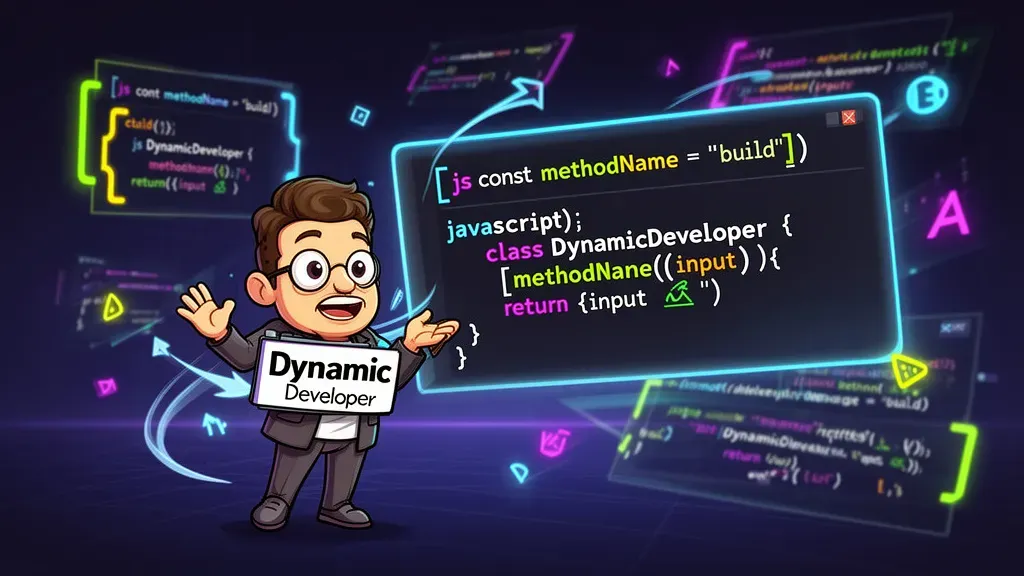
Computed property names let you dynamically define object keys using expressions enclosed in square brackets. This is especially powerful in JavaScript because object keys don’t have to be static strings; they can be evaluated at runtime, allowing for flexible and concise code.
In ES6, you can do this easily when creating objects. For example, if you want to create an object with a key based on a variable, you just wrap that variable in brackets:
const key = 'name';
const obj = {
  [key]: 'Paul'
};
console.log(obj.name); // "Paul"
Underneath, the JavaScript engine evaluates the expression inside the brackets and uses its result as the property name. This means you can even use function calls or complex expressions:
function getKey() {
  return 'greeting';
}

const obj = {
  [getKey()]: 'Hello, world!'
};

console.log(obj.greeting); // "Hello, world!"
The same principle applies when you’re defining methods inside classes. You can compute method names dynamically, which is a neat way to avoid repetition or generate API-like interfaces on the fly.
But it’s important to remember that the computed property name must resolve to a string (or symbol) because object keys can only be those types. If you try using a number or another value directly, JavaScript coerces it to a string:
const obj = {
  [42]: 'the answer'
};

console.log(obj['42']); // "the answer"
This behavior can sometimes cause hidden bugs if you are expecting the key to be a number. Also, symbols are unique and can be used as keys without collision risk, but they don’t show up in normal enumeration.
Computed property names open up a lot of possibilities but require careful thought about what expressions you are using, especially when they depend on external variables or functions that might change during runtime. They are a simple syntax feature with profound implications for dynamic coding patterns. Imagine generating all your event handlers based on a list of event names, or creating a proxy object that dynamically responds to keys constructed on the fly.
Even with classes, you can do this:
const methodName = 'sayHello';

class Greeter {
  [methodName]() {
    return 'Hello!';
  }
}

const g = new Greeter();
console.log(g.sayHello()); // "Hello!"
This makes your code more flexible and concise. But beware if the computed property relies on mutable data or external state, because changes there can alter your class’s interface unexpectedly. Next, we’ll see how to leverage these computed properties in more dynamic class methods without falling into common traps such as method overwrites or unexpected property shadowing. For now, keep in mind that the fundamental mechanic is simple: evaluate the expression inside brackets, convert it to a valid key type, and assign that as the property or method name. It’s simpler, but the implications ripple out into how you design your objects and classes.
Also note that if you use computed names multiple times within the same object or class, the last one wins:
const key = 'foo';

const obj = {
  [key]: 1,
  [key]: 2
};

console.log(obj.foo); // 2
This can cause subtle bugs if you copy-paste or generate keys programmatically without checking for duplicates. It’s a good reason to keep your computed keys unique or use Symbols when collisions are possible.
Lastly, you can combine computed property names with other features like template literals to create keys dynamically:
const prefix = 'data';
const id = 123;

const obj = {
  [${prefix}-${id}]: 'value'
};

console.log(obj['data-123']); // "value"
This pattern is common when dealing with data attributes or namespaced keys. It’s concise, expressive, and avoids manual concatenation outside the object literal. But remember, the more complex your computed keys get, the harder it’s to predict or debug them, so balance flexibility with clarity.
Computed property names are a small feature with big impact. They let you treat object and class definitions as templates that adapt to runtime information rather than static declarations. This opens doors to metaprogramming techniques that are otherwise cumbersome, especially when combined with proxies or decorators. But as always, the power comes with responsibility—you have to keep track of what keys you generate and how they interact with the rest of your codebase.
Understanding these mechanics thoroughly is the first step before you can leverage them effectively in class methods or avoid pitfalls that come with dynamic keys. In the next section, we’ll dive into practical ways to use computed property names to build dynamic class methods that feel natural and maintainable. Until then, try experimenting with computed keys in your own objects and see how they can simplify your code or help you avoid repetition. Just watch out for shadowing and unexpected overwrites as you go.
One subtlety worth mentioning: the computed property expression is evaluated once at the time the object or class is defined, not each time you access the property. This means it’s static in that sense, which can be counterintuitive if you come from languages where meta-level programming is more dynamic:
let counter = 0;

const obj = {
  ['key' + counter]: 'value'
};

counter++;

console.log(obj.key0); // "value"
console.log(obj.key1); // undefined
The key “key0” was baked in when the object was created, and changing counter afterward doesn’t retroactively change the keys. This behavior very important for reasoning about the stability of your object’s shape. If you want keys to change dynamically at access time, you’ll need proxies or explicit getter methods rather than computed keys.
Keep this distinction in mind as you start applying computed property names in your designs—whether in literal objects or class definitions. It’s the difference between static dynamicness and truly dynamic runtime behavior, and picking the right tool here will save you a lot of debugging headaches down the road.
Computed property names also interact interestingly with inheritance. When you extend a class and use computed names for methods, those names don’t get recalculated on subclass instantiation; they are part of the class’s prototype at definition time. So if your computed key depends on mutable variables shared across classes, you can unintentionally share method names or overwrite them in surprising ways.
This means that for dynamic method names in classes, it’s often better to compute the keys once, outside the class, and then use those constants inside the class body. For example:
const dynamicMethod = 'handleEvent';

class Base {
  [dynamicMethod]() {
    console.log('Base handler');
  }
}

class Derived extends Base {
  [dynamicMethod]() {
    console.log('Derived handler');
  }
}

const d = new Derived();
d.handleEvent(); // "Derived handler"
Here, both classes share the same method name, but since the method is overridden in Derived, the subclass method takes precedence. This behavior is expected but highlights how computed names can mask what methods you’re actually overriding when you rely on variables instead of explicit names.
So, understanding the mechanics means not just knowing the syntax, but also how evaluation timing, inheritance, and key uniqueness play together. Once you grasp these, you can start building more advanced patterns, like registering event handlers dynamically, building plugin systems, or creating APIs that adapt their methods based on configuration—all by using computed property names smartly.
One last note: besides strings, you can use Symbols as computed property keys to create hidden or non-enumerable properties. This is useful when you want to add methods or data to an object without exposing them in standard iteration or risking name clashes:
const secret = Symbol('secretMethod');

class SecretClass {
  [secret]() {
    return 'Top secret';
  }
}

const instance = new SecretClass();

console.log(instance[secret]()); // "Top secret"
console.log(Object.keys(instance)); // []
This technique combines the dynamic naming power of computed properties with the privacy features of Symbols, allowing for sophisticated encapsulation strategies. But be aware that Symbol-keyed properties aren’t accessible by normal dot notation or string keys, so you need to hold onto the Symbol reference to use them later.
Computed property names also enable patterns where you generate methods programmatically from arrays or data structures. For example:
const actions = ['start', 'stop', 'pause'];

class Player {
  constructor() {
    actions.forEach(action => {
      this[action] = () => console.log(Action: ${action});
    });
  }
}

const player = new Player();
player.start(); // "Action: start"
player.pause(); // "Action: pause"
This example uses instance properties rather than class methods, but you can similarly define methods with computed names directly in the class body if the method names are known upfront or imported from constants. It’s all a question of when and how you want those keys to be computed and what the lifecycle of those methods or properties should be.
The key takeaway is that computed property names provide a bridge between static code definitions and dynamic runtime behavior. They allow your code structure to adapt without sacrificing the declarative clarity of object or class literals. Mastering this feature means you can write cleaner, more adaptable code and avoid boilerplate patterns that otherwise clutter your projects.
Now that the mechanics are clear, we can move on to using these capabilities for dynamic class methods, where the real magic happens. But before that, watch out for some common pitfalls that can trip you up when using computed properties in classes, like method shadowing, unexpected key collisions, and evaluation order gotchas that can turn neat code into a debugging nightmare.
Here’s a quick snippet showing a subtle pitfall:
function getKey() {
  return 'greeting';
}

const obj = {
  [getKey()]: 'Hello, world!'
};

console.log(obj.greeting); // "Hello, world!"
Because method names collide, the second method overwrites the first without warning. That is a silent failure in JavaScript’s class syntax, so always ensure that your computed keys are unique within the same class body.
Another pitfall involves using mutable external values for computed keys that change between class definitions or instances, which leads to inconsistent interfaces. For example:
function getKey() {
  return 'greeting';
}

const obj = {
  [getKey()]: 'Hello, world!'
};

console.log(obj.greeting); // "Hello, world!"
This behavior can confuse users of your classes if they expect consistent method names. To prevent this, compute keys outside the class and keep them stable.
There’s also a gotcha when using computed property names with inheritance and super calls. Because method names are dynamic, calling super[methodName]() requires that the method exists on the prototype chain under the same computed key, which is not always guaranteed. This can lead to runtime errors if you’re not careful.
Understanding these subtle mechanics very important before adopting computed property names widely in your class designs. Once you have a solid grasp, you can harness them to make your code more modular, dynamic, and expressive without falling prey to common traps that lead to bugs and maintenance headaches.
Before moving on, try to think about how these mechanics apply in your current projects. Where can you replace repetitive code with computed property names? Where might you be unintentionally overwriting methods? How can you ensure that the keys you compute remain stable and predictable? These questions set the stage for using computed property names effectively and safely in more advanced scenarios.
Next, let’s explore how to leverage computed property names to create dynamic class methods that respond to varying contexts and data, making your classes truly adaptable and reducing boilerplate code dramatically. This is where the real benefit of understanding these mechanics shines through, and you’ll see practical patterns you can start using immediately.
Imagine a class that adapts its interface based on external configuration, generating different methods automatically without writing each one by hand. That is the kind of flexibility computed property names unlock when you use them right. But before we dive into that, remember that the key to success is a solid foundation in the mechanics—how and when computed names are evaluated, their types, and their interaction with inheritance and method overrides.
With this foundation, you’re ready to take the next peek into dynamic class method generation. But if you’re still curious about edge cases or want to experiment, try combining computed property names with proxies or decorators. These advanced techniques can further enhance your ability to write flexible, declarative code that adapts at runtime without sacrificing clarity.
Dynamic method names can also help with localization, feature toggling, and building fluent APIs. For example, generating methods like setLocaleEn, setLocaleFr, etc., based on a list of supported locales, can be done with computed property names and a loop outside the class. This keeps your class concise while still exposing a rich interface.
However, if you push this too far, your code can become hard to read and debug. The key is to balance dynamism with explicitness. Computed property names are a tool, not a silver bullet. When you understand how they work under the hood, you can wield them with precision and avoid the common pitfalls that trip up many developers.
In sum, the mechanics revolve around evaluation timing, key coercion, uniqueness, inheritance, and interaction with Symbols. Master these, and you’re well on your way to writing smarter, more adaptable JavaScript classes. The next section will show you how to leverage these capabilities to build dynamic class methods that actually improve your codebase instead of complicating it.
Keep experimenting, keep exploring, and next up: putting computed property names to work in dynamic methods.

Amazon Fire TV Alexa Voice Remote Pro (newest model) with remote finder, TV controls, and backlit buttons
$25.75 (as of July 19, 2026 03:41 GMT +00:00 - More infoProduct prices and availability are accurate as of the date/time indicated and are subject to change. Any price and availability information displayed on [relevant Amazon Site(s), as applicable] at the time of purchase will apply to the purchase of this product.)Using computed property names for dynamic class methods
One practical approach to dynamic class methods is to generate them from configuration objects or arrays. This pattern reduces boilerplate and centralizes method definitions, making your code easier to maintain and extend. For example:
const methodConfigs = {
  greet: name => Hello, ${name}!,
  farewell: name => Goodbye, ${name}!,
  shout: message => message.toUpperCase()
};

class Messenger {
  constructor(configs) {
    Object.entries(configs).forEach(([name, fn]) => {
      this[name] = fn;
    });
  }
}

const messenger = new Messenger(methodConfigs);
console.log(messenger.greet('Alice'));   // "Hello, Alice!"
console.log(messenger.farewell('Bob'));  // "Goodbye, Bob!"
console.log(messenger.shout('hey'));     // "HEY"
Here, methods are assigned directly to the instance, not the prototype. This means each instance has its own copy of the methods, which is fine for small methods or when you want to customize behavior per instance. But if you want shared methods on the prototype, computed property names can be used inside the class definition:
const methodNames = ['start', 'stop', 'reset'];

class Timer {
  [methodNames[0]]() {
    console.log('Timer started');
  }
  [methodNames[1]]() {
    console.log('Timer stopped');
  }
  [methodNames[2]]() {
    console.log('Timer reset');
  }
}

const timer = new Timer();
timer.start(); // "Timer started"
timer.stop();  // "Timer stopped"
timer.reset(); // "Timer reset"
This works well when you know the method names upfront. But if you want to generate an arbitrary number of methods dynamically, you can combine computed property names with a class factory function:
function createDynamicClass(methods) {
  return class {
    constructor() {
      // Optionally initialize instance state
    }
  };
}

const methodNames = ['foo', 'bar', 'baz'];

const DynamicClass = (() => {
  const proto = {};
  methodNames.forEach(name => {
    proto[name] = function() {
      console.log(Method called: ${name});
    };
  });
  return class {
    constructor() {}
  };
})();

Object.assign(DynamicClass.prototype, Object.fromEntries(
  methodNames.map(name => [name, function() {
    console.log(Method called: ${name});
  }])
));

const instance = new DynamicClass();
instance.foo(); // "Method called: foo"
instance.bar(); // "Method called: bar"
While this achieves dynamic method generation, it’s a bit verbose. Using class fields with arrow functions can also help if you want instance methods with lexical this binding:
const methods = ['log', 'warn', 'error'];

class Logger {
  constructor() {
    methods.forEach(method => {
      this[method] = (msg) => {
        console[method]([${method.toUpperCase()}]: ${msg});
      };
    });
  }
}

const logger = new Logger();
logger.log('This is a log message');
logger.warn('Warning issued');
logger.error('Error occurred');
This pattern is useful for delegating or wrapping existing APIs, and it keeps your class definition clean. But note that these methods live on the instance, not the prototype, so they consume more memory if you create many instances.
Another technique is to use computed property names together with getters to create dynamic method accessors that compute behavior on demand:
const methodNames = ['one', 'two', 'three'];

class Accessor {
  constructor() {
    this._values = { one: 1, two: 2, three: 3 };
  }

  get [methodNames[0]]() {
    return () => this._values.one;
  }

  get [methodNames[1]]() {
    return () => this._values.two;
  }

  get [methodNames[2]]() {
    return () => this._values.three;
  }
}

const a = new Accessor();
console.log(a.one());   // 1
console.log(a.two());   // 2
console.log(a.three()); // 3
That’s more verbose, but it lets you define computed properties that behave like methods, which can be useful when method definitions depend on internal state or require lazy computation.
When working with dynamic methods, it’s also common to combine computed property names with symbols to create methods that are hidden from external enumeration but still accessible internally:
const secretMethod = Symbol('secretMethod');

class HiddenMethods {
  [secretMethod]() {
    return 'This is secret';
  }

  reveal() {
    return this[secretMethod]();
  }
}

const obj = new HiddenMethods();
console.log(obj.reveal());         // "This is secret"
console.log(obj[secretMethod]());  // "This is secret"
console.log(Object.getOwnPropertyNames(obj)); // []
console.log(Object.getOwnPropertySymbols(obj)); // [ Symbol(secretMethod) ]
This approach is handy when you want to encapsulate helper methods or sensitive logic without exposing them as part of the public API. It leverages computed property names to assign symbol keys, ensuring uniqueness and privacy.
You can also generate dynamic methods that implement a form of delegation or proxying by using computed property names to forward calls:
const methods = ['fetch', 'save', 'delete'];

class Delegator {
  constructor(target) {
    methods.forEach(method => {
      this[method] = (...args) => target[method](...args);
    });
  }
}

const target = {
  fetch(id) { return Fetched ${id}; },
  save(data) { return Saved ${JSON.stringify(data)}; },
  delete(id) { return Deleted ${id}; }
};

const d = new Delegator(target);
console.log(d.fetch(42));                   // "Fetched 42"
console.log(d.save({ name: 'Test' }));     // "Saved {"name":"Test"}"
console.log(d.delete(42));                  // "Deleted 42"
This pattern is a simple way to create facade objects or API wrappers without manually writing each forwarding method. Computed property names and iteration combine to keep your code DRY and adaptable.
In summary, using computed property names for dynamic class methods lets you:
– Define methods based on external data or configuration.
– Reduce boilerplate by generating methods programmatically.
– Combine with symbols for private or hidden methods.
– Implement delegation or proxy patterns cleanly.
All these patterns rely on understanding when and how computed property names are evaluated and how they interact with the prototype chain and instance properties. Mastering these details lets you write classes whose interfaces adapt gracefully to changing requirements without sacrificing readability or maintainability.
Next, we’ll look at common pitfalls to avoid when using computed property names in classes, including overwrites, shadowing, and unexpected behavior caused by evaluation order or mutable keys. These traps can turn clever code into a source of bugs if you’re not vigilant.
Avoiding common pitfalls with computed properties in classes
One common pitfall with computed property names in classes is unintentionally overwriting methods when keys collide. Since JavaScript allows only one property per key, defining multiple computed methods with the same key means the last one silently replaces the previous.
const method = 'doStuff';

class Example {
  [method]() {
    console.log('First version');
  }
  [method]() {
    console.log('Second version');
  }
}

const e = new Example();
e.doStuff(); // Logs: "Second version"
This can be especially tricky when keys are generated programmatically or imported from external sources. Always ensure computed keys are unique, either by validating input or by using Symbols when uniqueness is critical.
Another trap is relying on mutable external variables for computed keys that might change between class declarations or instances. Because computed property names are evaluated once at class definition time, any changes to those variables afterward won’t affect the class interface, but can cause confusion:
let methodName = 'initial';

class Demo {
  [methodName]() {
    return 'Hello from initial';
  }
}

methodName = 'changed';

const d = new Demo();
console.log(typeof d.initial); // "function"
console.log(typeof d.changed); // "undefined"
Since the method name was fixed when the class was created, changing methodName later has no effect on existing classes. To avoid this, compute keys outside and keep them stable before defining the class.
Beware of evaluation order issues when computed property names depend on functions or variables that might throw or have side effects. Because the evaluation happens at class definition time, errors or unexpected results can disrupt your module loading or class creation:
function getKey() {
  throw new Error('Oops!');
}

class Faulty {
  [getKey()]() {
    console.log('This will never run');
  }
}
Here, the error is thrown immediately when the class is parsed, not when the method is called. This differs from normal method calls and requires careful handling of any expressions inside computed keys.
Inheritance introduces its own set of pitfalls. When overriding methods with computed names, it’s easy to lose track of which keys are actually shared between base and derived classes. That’s especially problematic if keys are generated dynamically or come from mutable sources:
const key = 'process';

class Base {
  [key]() {
    console.log('Base processing');
  }
}

class Derived extends Base {
  [key]() {
    console.log('Derived processing');
  }
}

const obj = new Derived();
obj.process(); // "Derived processing"
While this looks simpler, if key changes or is different at the time each class is defined, the overriding won’t happen as expected, leading to subtle bugs in polymorphism.
Another subtlety is with super calls inside computed methods. Because method names are dynamic, calling super[methodName]() requires that the base class prototype actually has a method under that exact key. If it doesn’t, you’ll get a runtime error:
const methodName = 'run';

class Base {
  [methodName]() {
    console.log('Base run');
  }
}

class Child extends Base {
  [methodName]() {
    super[methodName]();
    console.log('Child run');
  }
}

const c = new Child();
c.run();
// Output:
// Base run
// Child run
If the base class lacks the computed method or if the key is inconsistent, super[methodName]() will fail. Always ensure your computed keys align across inheritance chains.
Using Symbols as computed keys can prevent collisions but introduces other challenges. Symbol-keyed methods are not accessible via dot notation and don’t appear in normal property enumerations, which can make debugging or interfacing with other code harder:
const sym = Symbol('secret');

class Hidden {
  [sym]() {
    return 'hidden method';
  }
}

const h = new Hidden();
console.log(h[sym]());     // "hidden method"
console.log(h.secret);     // undefined
console.log(Object.keys(h)); // []
Because Symbols are not enumerable and don’t have simpler string keys, you must keep references to them to use or test these methods. Losing the Symbol reference means losing access.
Another frequent mistake is mixing instance properties and prototype methods when using computed names. Defining methods inside the constructor as instance properties creates separate functions per instance, increasing memory usage, while defining them on the prototype shares a single function but requires static keys or more complex patterns.
const methods = ['foo', 'bar'];

class Demo {
  constructor() {
    methods.forEach(name => {
      this[name] = () => console.log(Instance method: ${name});
    });
  }
}

const d1 = new Demo();
const d2 = new Demo();

console.log(d1.foo === d2.foo); // false
In contrast, prototype methods defined via computed names inside the class body share the same function:
class DemoProto {
  ['foo']() {
    console.log('Prototype method foo');
  }
}

const d1 = new DemoProto();
const d2 = new DemoProto();

console.log(d1.foo === d2.foo); // true
Choosing between these approaches depends on your use case, but mixing them unintentionally can cause inconsistent behavior or performance issues.
Finally, watch out for debugging difficulties caused by computed property names. Since method names may be generated dynamically, stack traces and error messages might show unfamiliar or unexpected method names, making tracing problems harder. Using clear, stable keys and consistent naming conventions helps mitigate this.
In summary, avoiding pitfalls with computed property names in classes involves:
– Ensuring computed keys are unique and stable.
– Avoiding mutable or side-effecting expressions in keys.
– Aligning computed keys across inheritance hierarchies.
– Carefully handling super calls with dynamic keys.
– Using Symbols with awareness of their accessibility limitations.
– Distinguishing instance methods from prototype methods to avoid memory bloat.
– Maintaining clear naming conventions to ease debugging.
By keeping these considerations in mind, you can harness computed property names effectively without falling into common traps that complicate your codebase and increase maintenance costs.