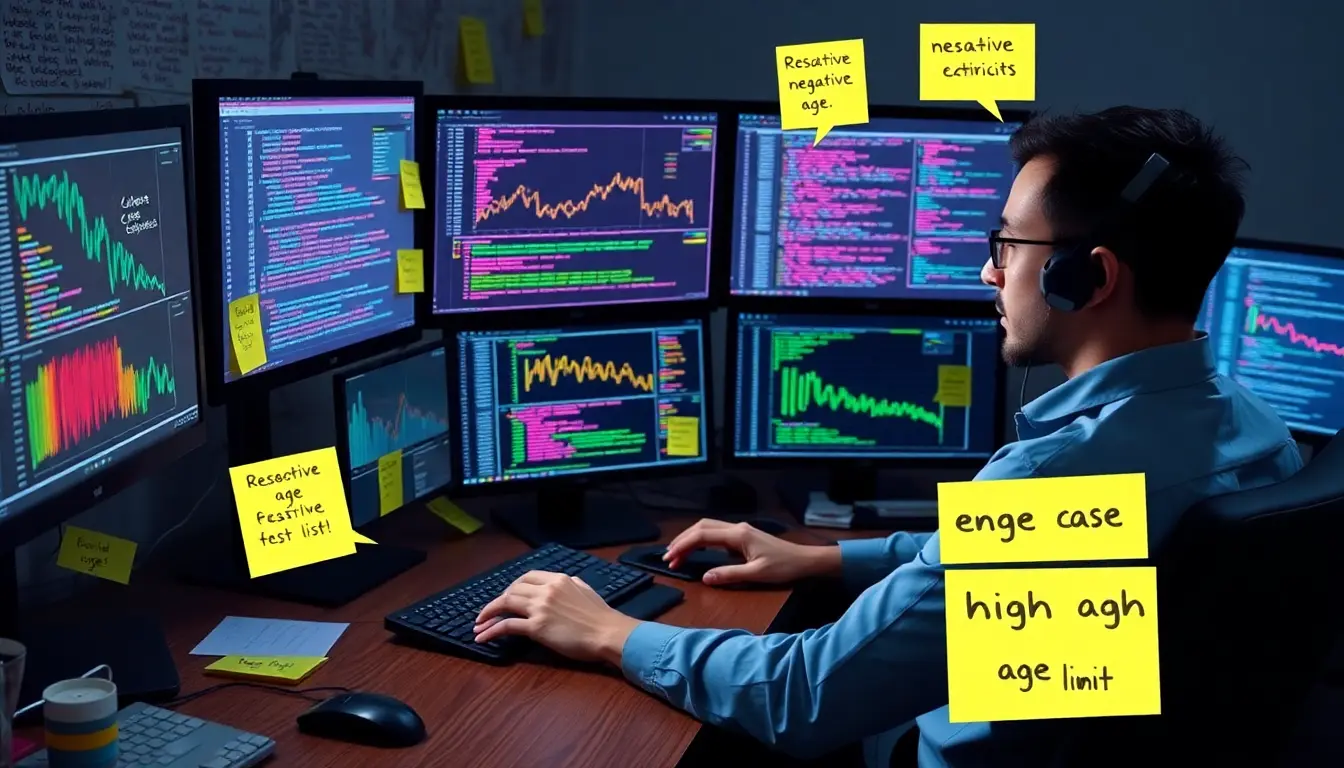
Choosing the right inputs for testing especially important. It’s not just about covering the happy paths; you need to explore the edge cases that can reveal hidden issues. When designing your test cases, think about the inputs that can cause your code to behave unexpectedly. Consider various types of inputs: valid, invalid, boundary values, and even unexpected data types.
For instance, if you’re working with a function that processes user ages, you should test not just typical values like 25 or 30, but also edge cases like 0, negative numbers, and extremely high values. Here’s a simple example of a function that checks if the age is valid:
function isValidAge(age) {
  return age >= 0 && age <= 120;
}
It is time to create a set of test cases to ensure we cover all bases:
const testAges = [-5, 0, 25, 120, 150];
testAges.forEach(age => {
  console.log(Age ${age} is valid: ${isValidAge(age)});
});
When you run this code, you’ll see how each input is handled, providing insights into the function’s robustness. It’s essential to think critically about what constitutes a valid input and prepare accordingly. This approach not only ensures thorough coverage but also helps in understanding the function’s limitations and potential failure points.
Another aspect to consider is the format and type of inputs. If your function expects a string but receives a number, how does it behave? You can implement type checking to reinforce your function’s integrity:
function isValidAge(age) {
  if (typeof age !== 'number') {
    return false;
  }
  return age >= 0 && age <= 120;
}
This adjustment adds an extra layer of safety and ensures that your tests reflect realistic scenarios. When you run your tests with various data types, you’ll see how this change impacts your function’s response. Keep in mind, the goal is not just to find bugs but to build a comprehensive understanding of your code’s behavior under different conditions.

Highwings 8K 10K 4K HDMI Cable 48Gbps 6.6FT/2M, Certified Ultra High Speed 2.1 HDMI Cable Braided Cord-4K@120Hz 8K@60Hz, DTS:X, HDCP 2.2 & 2.3, HDR 10 Compatible with DVD Player/PS5/HDTV/Blu-ray
$5.99 (as of July 19, 2026 03:41 GMT +00:00 - More infoProduct prices and availability are accurate as of the date/time indicated and are subject to change. Any price and availability information displayed on [relevant Amazon Site(s), as applicable] at the time of purchase will apply to the purchase of this product.)Automating test execution with JavaScript frameworks
Automating test execution can significantly streamline your development process, especially when working with JavaScript frameworks like Jest, Mocha, or Jasmine. These frameworks provide powerful tools for writing and running your tests with minimal overhead. First, you need to set up your testing environment. For instance, if you choose Jest, you can install it via npm:
npm install --save-dev jest
Once installed, you can create a simple test file to verify your functions. Here’s an example of how to structure a test for the isValidAge function:
const { isValidAge } = require('./yourModule');

test('valid ages', () => {
  expect(isValidAge(25)).toBe(true);
  expect(isValidAge(0)).toBe(true);
  expect(isValidAge(120)).toBe(true);
});

test('invalid ages', () => {
  expect(isValidAge(-1)).toBe(false);
  expect(isValidAge(121)).toBe(false);
  expect(isValidAge('twenty')).toBe(false);
});
With this setup, running your tests is as simple as executing a command in your terminal:
npx jest
This command will automatically discover your test files and execute them, providing a summary of the results. The output will help you quickly identify which tests passed and which failed. This feedback loop is important for maintaining code quality as you iterate on your projects.
In addition to basic assertions, you can use advanced features like mocking and spies to isolate your tests. For instance, if your function interacts with external services, you can mock those dependencies to ensure your tests are focused solely on the logic of the function itself:
jest.mock('externalService', () => ({
  fetchData: jest.fn(() => Promise.resolve('mocked data')),
}));

test('fetches data successfully', async () => {
  const data = await externalService.fetchData();
  expect(data).toBe('mocked data');
});
This allows you to simulate various scenarios, such as error handling or slow responses, without relying on the actual implementation of the external service. It is a powerful way to ensure your code behaves correctly under different conditions.
As you automate your tests, consider integrating them into your continuous integration (CI) pipeline. Tools like Travis CI or GitHub Actions can automatically run your tests on every commit, ensuring that new changes don’t break existing functionality. Here’s a basic configuration for GitHub Actions:
name: CI

on:
  push:
    branches: [ main ]
  pull_request:
    branches: [ main ]

jobs:
  test:
    runs-on: ubuntu-latest
    steps:
      - name: Checkout code
        uses: actions/checkout@v2

      - name: Set up Node.js
        uses: actions/setup-node@v2
        with:
          node-version: '14'

      - name: Install dependencies
        run: npm install

      - name: Run tests
        run: npm test
This configuration ensures that every time you push changes to the main branch or open a pull request, your tests will run automatically, providing immediate feedback on the state of your code. Automating test execution not only saves time but also enhances the reliability of your codebase, making it easier to catch issues early.
While automation is key, analyzing test results is equally important. After running your tests, take the time to scrutinize the output. Identify patterns in failures and consider edge cases that may not have been anticipated. This reflective process can lead to valuable insights about your code’s behavior and its interactions with various inputs.
Analyzing test results to pinpoint edge cases
Start by examining your test reports closely. Focus on failed test cases and categorize them to understand the nature of the failures. Are they caused by input boundaries, unexpected data types, or asynchronous timing issues? The clearer the classification, the easier it becomes to formulate a remediation strategy.
Consider enhancing your tests with detailed logging to capture the exact inputs and internal state of the application at the moment of failure. This can help recreate complex scenarios that are otherwise hard to replicate. For example, use assertion messages to clarify the failure context:
test('rejects negative ages', () => {
  const age = -1;
  expect(isValidAge(age)).toBe(false);
}, 'Expected isValidAge to return false for negative values');
Failing tests sometimes reveal overlooked edge cases. One approach to systematically uncover these is property-based testing. Instead of manually enumerating input values, generate a wide range of inputs within and beyond expected domains and test your functions against invariants. Libraries like fast-check facilitate this:
const fc = require('fast-check');

test('isValidAge should return false for invalid ages', () => {
  fc.assert(
    fc.property(fc.oneof(fc.integer({ max: -1 }), fc.integer({ min: 121 })), (age) => {
      return isValidAge(age) === false;
    })
  );
});
This approach efficiently explores combinations of inputs you might not have considered, making it easier to pin down problematic edge cases.
When analyzing output from asynchronous tests or operations involving complex data, formatting the results for easier inspection is beneficial. For instance, rather than simply dumping entire objects, selectively log relevant properties or even leverage snapshot testing:
test('processUserData maintains structure', () => {
  const userData = { id: 123, name: 'Alice', age: 30 };
  const result = processUserData(userData);
  expect(result).toMatchSnapshot();
});
Snapshot failures can highlight unintended changes in output over time, signaling edge case handling regressions or unintended side effects.
If a failure stems from timing or concurrency issues, analysis often requires delving into the order of operations. Use tools to trace asynchronous calls or debuggers to step through execution. Adding timestamps or sequence IDs to logs can aid you in understanding race conditions or state inconsistencies.
async function exampleAsync() {
  const start = Date.now();
  await someAsyncOperation();
  console.log(Operation completed in ${Date.now() - start}ms);
}
Finally, maintain a feedback loop between your test results and the design of your test inputs. Use the insights gained from failed tests to refine your input selection heuristics. Automate the extraction of failed input cases and incorporate them as regression tests to prevent future reintroduction of bugs.