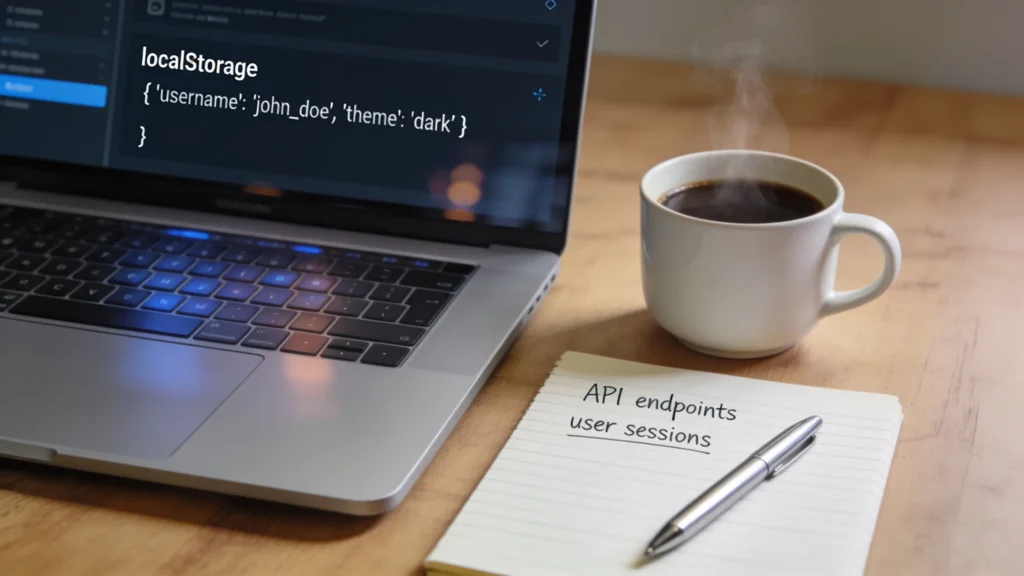
sessionStorage is part of the Web Storage API, designed to store data locally for a specific window or tab session. Unlike localStorage, which persists until explicitly cleared, sessionStorage lasts only for the duration of the page session. Once the tab or window is closed, all stored data is discarded. This behavior makes sessionStorage ideal for temporary data that shouldn’t survive beyond the user’s interaction with a single session.
The value proposition of sessionStorage lies in its scope and lifecycle. It’s scoped to the origin as well as to the window or tab, so if you open two tabs to the same domain, each tab will hold its own separate sessionStorage object. This isolation helps prevent cross-tab data leakage, which is often a concern with shared storage like localStorage.
Typical use cases revolve around maintaining state that’s relevant only during the visit. For example, preserving the user’s progress in a multi-step form or wizard is a common scenario. If a user reloads the page accidentally, the current step or partially entered data can be restored without needing a backend roundtrip. Similarly, sessionStorage can hold temporary UI state, like whether certain panels are expanded or collapsed, or caching data fetched from the server that doesn’t need to persist beyond the session.
sessionStorage isn’t a replacement for server-side sessions or authentication tokens, though. Its ephemeral nature and client-side accessibility mean it shouldn’t be trusted with sensitive information. Use it for convenience and improving user experience, but continue to rely on secure server-side mechanisms for critical data.
Here’s a quick example of its basic usage to get a feel for how simpler it is:
function saveUserData(name, age) {
  sessionStorage.setItem('userName', name);
  sessionStorage.setItem('userAge', age);
}

function getUserData() {
  const name = sessionStorage.getItem('userName');
  const age = sessionStorage.getItem('userAge');
  return { name, age };
}

saveUserData('Alice', 30);
console.log(getUserData()); // { name: 'Alice', age: '30' }
The key-value pairs are always strings, so remember to serialize more complex objects if you need to store them:
function saveUserPreferences(preferences) {
  sessionStorage.setItem('prefs', JSON.stringify(preferences));
}

function getUserPreferences() {
  const prefs = sessionStorage.getItem('prefs');
  return prefs ? JSON.parse(prefs) : null;
}

saveUserPreferences({ theme: 'dark', fontSize: 14 });
console.log(getUserPreferences()); // { theme: 'dark', fontSize: 14 }
Understanding the lifecycle of sessionStorage is critical. Data persists through reloads and restores, but closes entirely once the tab or window ends. You cannot share it between tabs, which distinguishes it from localStorage, and it provides a guarantee that you won’t accidentally leak session data across browser sessions or between tabs.
This model fits very well for single-page apps or complex forms where keeping a local state isolated per tab makes the code more maintainable and uncomplicated to manage. It avoids the need to dirty server or backend with temporary, transient session data that has no place in permanent storage.
Using sessionStorage effectively means knowing when it’s better than alternatives like cookies (which still have a niche in server communication) or more heavy-handed client storage like IndexedDB, especially where synchronous access and simplicity are favored over the complexity of asynchronous storage management.
This is why when you need to manage short-lived session data confined to a tab, sessionStorage is often the simplest tool for the job. But to get there, you need to be aware of its scope, behavior, and limitations, so your code doesn’t betray the storage’s ephemeral promise. If the data must follow the user across tabs or persist longer, localStorage or a backend solution is required, or a combination of both with synchronization logic.
Given these properties, sessionStorage is well-suited to keep intermediate form data or UI state without messing with your application’s business logic or overcomplicating state management. Just don’t rely on it for anything critical without fallback mechanisms, and remember that serialization format consistency will save hours of debugging down the line.
How you leverage sessionStorage reflects your design trade-offs—whether you choose to update the stored data frequently, clear it proactively during navigation events, or rely on its automatic clearing upon tab close shapes the user experience and resource use in subtle but meaningful ways. This aspect leads us directly into managing sessionStorage during the lifespan of the session itself—

2 Pack for Samsung Galaxy Watch Charger Compatible with Watch 8/8 Classic/Ultra/7/6/6 Classic/5/5 Pro/4/4 Classic/3/Active/FE USB A Magnetic Charging Docks Accessories 3.3FT
$8.99 (as of July 19, 2026 03:41 GMT +00:00 - More infoProduct prices and availability are accurate as of the date/time indicated and are subject to change. Any price and availability information displayed on [relevant Amazon Site(s), as applicable] at the time of purchase will apply to the purchase of this product.)Storing and retrieving data in sessionStorage
which involves understanding when to clean up or update stored data. For instance, if you’re using sessionStorage to track user progress through a multi-step form, it’s essential to ensure that stale data doesn’t linger beyond its useful life. This can be accomplished by actively clearing or updating the stored values as users navigate through the form.
Here’s a simple implementation that clears the sessionStorage upon form submission:
function submitForm() {
  // Perform form submission logic here
  // ...

  // Clear sessionStorage after submission
  sessionStorage.clear();
}
In scenarios where you might want to maintain some data but update others, consider selectively removing items:
function updateFormStep(currentStep) {
  // Update the current step in sessionStorage
  sessionStorage.setItem('currentStep', currentStep);

  // Remove outdated data if necessary
  if (currentStep === 1) {
    sessionStorage.removeItem('previousStepData');
  }
}
Another best practice involves using a consistent naming convention for your sessionStorage keys. This helps avoid collisions and keeps your code organized. For instance, prefixing keys with the component name or feature can make it clear where and how the data is being used:
const STORAGE_PREFIX = 'myApp_';

function saveFormData(data) {
  sessionStorage.setItem(${STORAGE_PREFIX}formData, JSON.stringify(data));
}

function getFormData() {
  const data = sessionStorage.getItem(${STORAGE_PREFIX}formData);
  return data ? JSON.parse(data) : null;
}
Moreover, it’s beneficial to implement checks to ensure that your sessionStorage access is robust. For instance, if a user disables storage in their browser, your application should handle these cases gracefully:
function safeSetItem(key, value) {
  try {
    sessionStorage.setItem(key, value);
  } catch (e) {
    console.error('Failed to set item in sessionStorage:', e);
  }
}

function safeGetItem(key) {
  try {
    return sessionStorage.getItem(key);
  } catch (e) {
    console.error('Failed to get item from sessionStorage:', e);
    return null;
  }
}
These practices not only improve the reliability of your application but also enhance the overall user experience by preventing unexpected behavior. By ensuring that your code is resilient to potential issues with sessionStorage, you can focus more on delivering functionality rather than debugging storage-related problems.
As you manage sessionStorage, consider the implications of data size limits. Browsers typically impose a limit on the amount of data you can store, usually around 5-10MB per origin. If you find yourself frequently hitting these limits, it may be time to reassess your data storage strategy. In such cases, exploring IndexedDB or other storage solutions could provide a more scalable alternative.
In summary, effectively managing sessionStorage requires attention to detail in how data is stored, updated, and removed. It’s a valuable tool for enhancing user experience when used appropriately, but it’s equally important to recognize its limitations and the need for alternative strategies in certain situations. Balancing these aspects ensures that your application remains responsive and effortless to handle throughout the session.
As you implement these strategies, keep in mind that the key to successful session data management lies in a clear understanding of your application’s workflow and user interactions. This insight will guide your decisions on when to store, update, or clear sessionStorage data, ultimately leading to a smoother user experience. The next consideration is how to handle scenarios where sessionStorage data might need to be synchronized or shared across different components or parts of your application—
Best practices for managing sessionStorage data
and this often requires a thoughtful approach to state management. When multiple components rely on the same sessionStorage data, it’s crucial to establish a pattern for reading from and writing to this shared state. One common strategy is to create a centralized module or utility that encapsulates all interactions with sessionStorage. This encapsulation allows you to manage changes in a single place, making your codebase cleaner and more maintainable.
const StorageService = {
  setItem(key, value) {
    try {
      sessionStorage.setItem(key, JSON.stringify(value));
    } catch (e) {
      console.error('Storage error:', e);
    }
  },

  getItem(key) {
    try {
      const value = sessionStorage.getItem(key);
      return value ? JSON.parse(value) : null;
    } catch (e) {
      console.error('Storage error:', e);
      return null;
    }
  },

  removeItem(key) {
    sessionStorage.removeItem(key);
  },

  clear() {
    sessionStorage.clear();
  }
};
By using a service like this, you can ensure consistent handling of sessionStorage across your application. This approach also allows you to implement additional features, such as event dispatching when data changes, which can help keep your UI in sync with the stored state.
function notifyDataChange(key) {
  const event = new Event('sessionStorageChange');
  event.key = key;
  window.dispatchEvent(event);
}

StorageService.setItem = function(key, value) {
  sessionStorage.setItem(key, JSON.stringify(value));
  notifyDataChange(key);
};
Listening for these changes can be particularly useful in single-page applications where components may need to react to updates in sessionStorage without reloading the page:
window.addEventListener('sessionStorageChange', function(event) {
  console.log('Session storage changed for key:', event.key);
  // Update UI or state accordingly
});
Another aspect to consider is the lifecycle of the stored data. While sessionStorage is automatically cleared when the tab is closed, you might want to implement a manual cleanup strategy based on user actions. For example, if a user navigates away from a particular component or completes a task, it’s a good idea to clear any session data that’s no longer relevant.
function onComponentUnmount() {
  StorageService.removeItem('currentStep');
  StorageService.removeItem('prefs');
}
This practice prevents stale data from lingering in sessionStorage, keeping your application’s state fresh and relevant. Additionally, consider using time-based expiration for certain data. You can store a timestamp alongside your data in sessionStorage and check it before using the data, thereby ensuring that it’s still valid:
function setItemWithExpiry(key, value, ttl) {
  const now = new Date();
  const item = {
    value: value,
    expiry: now.getTime() + ttl,
  };
  StorageService.setItem(key, item);
}

function getItemWithExpiry(key) {
  const item = StorageService.getItem(key);
  const now = new Date();

  if (!item) {
    return null;
  }

  if (now.getTime() > item.expiry) {
    StorageService.removeItem(key);
    return null;
  }
  return item.value;
}
Incorporating these best practices into your sessionStorage management will result in a more robust and effortless to handle application. By centralizing access to sessionStorage and implementing clear strategies for data handling, you can avoid common pitfalls and enhance the overall experience for your users. Remember, while sessionStorage is a powerful tool for managing temporary data, it should always be used judiciously within the larger context of your application’s architecture and user needs.
As you refine your approach to sessionStorage, consider integrating it with broader state management solutions if your application grows in complexity. This hybrid approach can provide the flexibility needed to handle various data persistence requirements while maintaining a clear separation of concerns. Ultimately, understanding the nuances of sessionStorage will empower you to build more responsive and resilient web applications.