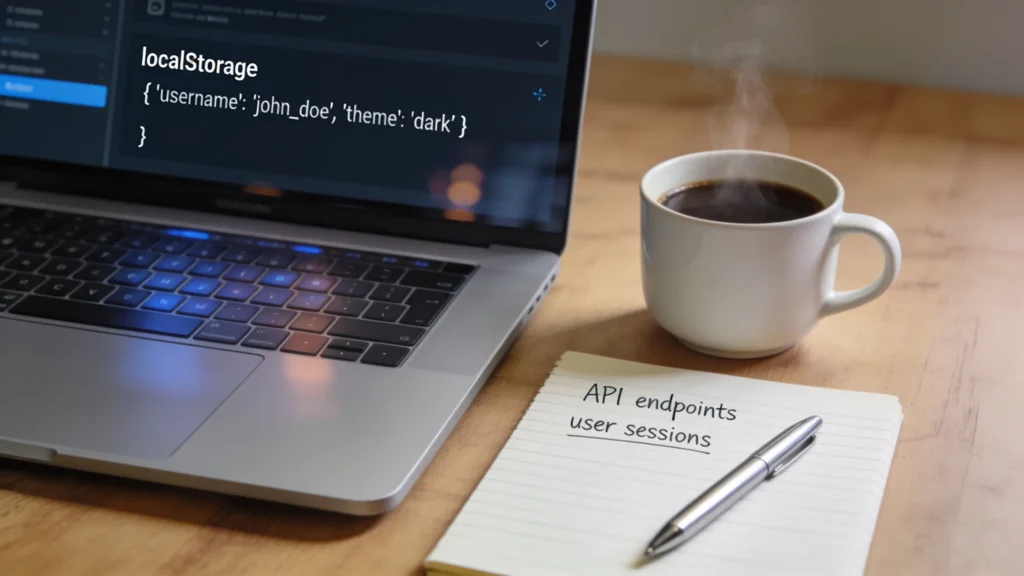
sessionStorage is a simple but surprisingly powerful feature baked into modern browsers. Unlike localStorage, which persists data indefinitely, sessionStorage ties data to the lifetime of the page session. That means when the tab or window closes, the stored data vanishes. This makes sessionStorage perfect for temporary state that shouldn’t outlive the user’s current browsing context.
Think of sessionStorage as a quick scratchpad for your web app. It’s perfect for cases where you want to save user inputs, UI state, or small amounts of data across page reloads without polluting localStorage or relying on cookies. For example, if you have a multi-step form split across different pages, sessionStorage lets you keep track of answers without sending them back to the server prematurely or saving them permanently.
Another compelling use case is storing ephemeral tokens or flags. You might fetch a short-lived API token on page load and stash it in sessionStorage so you can reuse it without repeated requests, yet it disappears once the user closes the tab. Similarly, feature flags or UI toggles that only need to persist during the session fit naturally here.
One practical detail worth noting is sessionStorage’s per-origin and per-tab isolation. Each tab running your site gets its own independent sessionStorage. This avoids accidental data leakage across tabs but requires you to carefully design how multi-tab workflows behave if your app supports them.
Accessing sessionStorage is simpler since it’s a synchronous API exposed on the window object. Here’s the basic pattern for setting and getting data:
window.sessionStorage.setItem('key', 'value');
const val = window.sessionStorage.getItem('key');
It stores everything as strings, so if you want to save objects or arrays, you’ll need to serialize with JSON:
const user = { name: 'Alice', age: 30 };
window.sessionStorage.setItem('user', JSON.stringify(user));

const storedUser = JSON.parse(window.sessionStorage.getItem('user'));
But be aware of sessionStorage’s limitations. It’s usually capped at around 5MB per origin, so don’t treat it like a database. Also, it’s synchronous, so if you’re storing large chunks, you’ll risk blocking the main thread. For heavy-duty persistence, IndexedDB or server-side storage are better options.
Since sessionStorage is tied to a tab, refreshing the page keeps your data intact, but opening a new tab with the same URL won’t share that data. This subtlety means you can’t easily share session state across tabs without more elaborate messaging mechanisms or server coordination.
Security-wise, sessionStorage is subject to the same-origin policy, so one domain can’t access another’s data. However, it’s still accessible to any script running on your page, so never store sensitive info like passwords or long-lived tokens here. Treat it as a convenience, not a vault.
In sum, sessionStorage shines as a lightweight, temporary client-side store, a handy spot to keep state through reloads but not beyond. It’s less about persistence and more about convenience for the current session’s lifetime.

Braided Stretchy Band Compatible with Apple Watch Bands 38mm 40mm 41mm 42mm 44mm 45mm 46mm 49mm Women Men, Soft Nylon Solo Loop Magnetic Sport Strap for iWatch Series 11 10 9 8 7 6 5 4 3 2 1 SE Ultra
$8.90 (as of July 19, 2026 03:41 GMT +00:00 - More infoProduct prices and availability are accurate as of the date/time indicated and are subject to change. Any price and availability information displayed on [relevant Amazon Site(s), as applicable] at the time of purchase will apply to the purchase of this product.)Retrieving and manipulating data stored in sessionStorage
Retrieving data from sessionStorage is as simple as calling getItem. If the key exists, you get back the stored string; if not, you get null. This means you often want to check for existence before using the value to avoid surprises:
const data = window.sessionStorage.getItem('myKey');
if (data !== null) {
  // use data safely here
} else {
  // handle missing data case
}
When working with JSON-serialized data, robust code usually wraps the JSON.parse call in a try-catch to guard against malformed or unexpected input, especially if the storage might have been corrupted or tampered with:
function getJson(key) {
  const val = window.sessionStorage.getItem(key);
  if (!val) return null;
  try {
    return JSON.parse(val);
  } catch (e) {
    console.warn('Failed to parse sessionStorage key:', key);
    return null;
  }
}
Manipulating data in sessionStorage is just as simpler. To update a stored value, you overwrite it with setItem. If you’re dealing with objects, retrieve, modify, then re-store the serialized version:
let settings = getJson('settings') || {};
settings.theme = 'dark';
window.sessionStorage.setItem('settings', JSON.stringify(settings));
If you want to remove a specific entry, removeItem does the job without affecting other stored keys:
window.sessionStorage.removeItem('settings');
Clearing all sessionStorage data for the current origin is done with clear(). This is handy when you want to reset the session state entirely, such as on user logout:
window.sessionStorage.clear();
Because sessionStorage is synchronous, multiple operations in quick succession can cause performance bottlenecks in complex apps. To minimize this, batch your reads and writes instead of scattering them, or keep data in memory and sync to sessionStorage only when necessary.
One subtlety: sessionStorage keys and values are always strings. This means you can’t store functions, dates, or other complex types directly. You have to convert them to string representations that you can reliably reconstruct later. For example, dates can be saved as ISO strings and revived with new Date():
const now = new Date();
window.sessionStorage.setItem('lastVisit', now.toISOString());

const storedDate = new Date(window.sessionStorage.getItem('lastVisit'));
For boolean flags, it’s common to store 'true' or 'false' strings, then convert back explicitly:
window.sessionStorage.setItem('isAdmin', 'true');

const isAdmin = window.sessionStorage.getItem('isAdmin') === 'true';
SessionStorage events can be useful for cross-tab communication, but remember that these events only fire in other tabs, not the tab that made the change. The event is storage, and you can listen for it to react when sessionStorage updates elsewhere:
window.addEventListener('storage', (event) => {
  if (event.storageArea === window.sessionStorage) {
    console.log('sessionStorage changed:', event.key, event.newValue);
  }
});
This can be a tool to synchronize UI state or trigger reloads, but it requires multiple tabs to be open simultaneously and does not work for the tab that made the change.