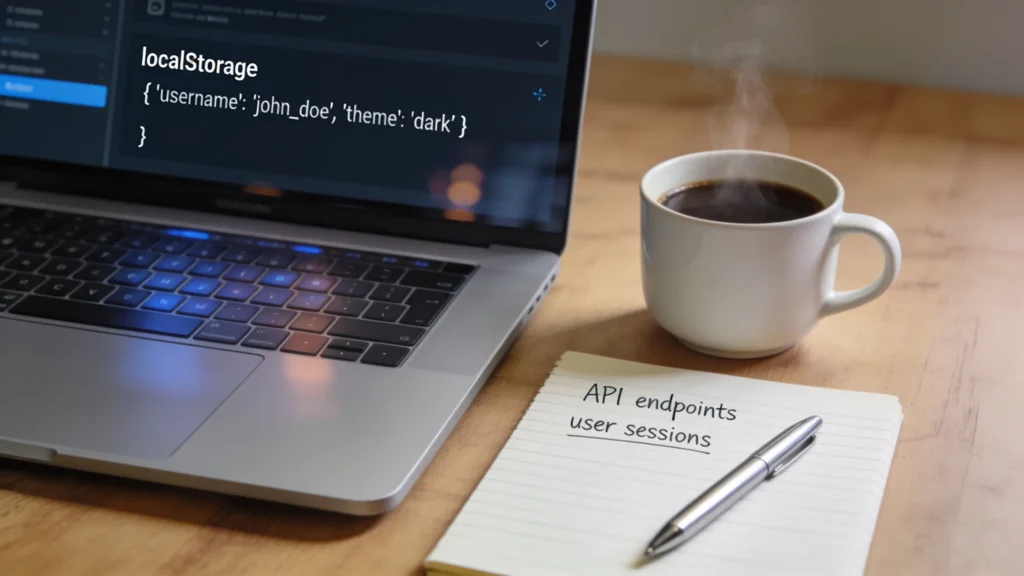
The web storage API provides a simple way to store key-value pairs in a web browser. One of its components, sessionStorage, is particularly useful for managing temporary data that should only persist for the duration of a page session. This means the data is available as long as the browser tab is open, but it will be cleared once the tab is closed.
Unlike cookies, which are sent to the server with every HTTP request, sessionStorage is designed for client-side use. This can lead to performance improvements, especially in applications that require frequent access to temporary data.
To use sessionStorage, you can simply call its methods: setItem, getItem, removeItem, and clear. Here’s a quick overview of these methods:
sessionStorage.setItem('key', 'value');
const value = sessionStorage.getItem('key');
sessionStorage.removeItem('key');
sessionStorage.clear();
When you store an object, you’ll need to serialize it using JSON. This is because sessionStorage can only store strings. Here’s how you can do it:
const user = { name: 'Alice', age: 30 };
sessionStorage.setItem('user', JSON.stringify(user));

const storedUser = JSON.parse(sessionStorage.getItem('user'));
console.log(storedUser.name); // Alice
One of the key aspects of sessionStorage is its scope. Data stored in one tab is not accessible in another tab, even if they are on the same origin. That is an important distinction compared to localStorage, where data persists across all tabs and windows. Understanding this can help prevent potential data leaks and unintended data sharing between tabs.
Another point worth noting is that sessionStorage is limited in size, typically around 5MB, which varies by browser. This should be sufficient for many use cases, but it is always good to keep an eye on the amount of data you’re storing.
When it comes to clearing data, you have a couple of options. You can manually remove specific items, or you can clear the entire storage. Here’s how you can efficiently manage your sessionStorage:
function clearUserSession() {
  sessionStorage.removeItem('user');
}
In a situation where you need to reset multiple keys, using a loop can be effective:
const keysToClear = ['user', 'tempData', 'settings'];
keysToClear.forEach(key => sessionStorage.removeItem(key));
It’s also important to consider the lifecycle of the data you’re storing. For instance, if you’re building a form that collects user input, you might want to keep that data in sessionStorage while the user fills out the form but clear it once the form is submitted or when the user navigates away.
Using sessionStorage can greatly enhance the user experience by providing quick access to temporary data without the overhead of server requests. However, developers need to be mindful of its limitations and manage it effectively to avoid potential pitfalls, such as data loss on tab closure or exceeding storage limits.
Exploring the practical methods for clearing sessionStorage data is essential for maintaining a clean state in your applications…

𝟐𝟎𝟐𝟔 𝐔𝐩𝐠𝐫𝐚𝐝𝐞𝐝 for Apple Watch Charger Magnetic Fast Charging Cable [Portable] Magnetic Wireless Charging Compatible with iWatch Series Ultra/SE/11/10/9/8/7/6/5/4/-[3.3FT] White
$8.99 (as of July 18, 2026 03:40 GMT +00:00 - More infoProduct prices and availability are accurate as of the date/time indicated and are subject to change. Any price and availability information displayed on [relevant Amazon Site(s), as applicable] at the time of purchase will apply to the purchase of this product.)Practical methods for clearing sessionStorage data
Sometimes, you need to clear all data stored in sessionStorage at once. This is simpler with the clear() method, which wipes the entire storage for the current session:
sessionStorage.clear();
However, indiscriminately clearing all data can be risky if your application stores multiple unrelated pieces of information. A more controlled approach is to namespace your keys, so you can selectively clear groups of data. For example, prefix keys related to user preferences with prefs_:
const prefsPrefix = 'prefs_';

// Remove all keys starting with 'prefs_'
for (let i = sessionStorage.length - 1; i >= 0; i--) {
  const key = sessionStorage.key(i);
  if (key.startsWith(prefsPrefix)) {
    sessionStorage.removeItem(key);
  }
}
Note the reverse iteration in the loop. This is intentional: when removing items during iteration, going backward prevents skipping keys due to the storage’s dynamic nature when keys are removed.
Another practical pattern is to wrap sessionStorage operations in utility functions that handle serialization and key management, making clearing and accessing data more predictable and less error-prone:
const StorageUtil = {
  prefix: 'app_',

  set(key, value) {
    sessionStorage.setItem(this.prefix + key, JSON.stringify(value));
  },

  get(key) {
    const item = sessionStorage.getItem(this.prefix + key);
    return item ? JSON.parse(item) : null;
  },

  remove(key) {
    sessionStorage.removeItem(this.prefix + key);
  },

  clearAll() {
    for (let i = sessionStorage.length - 1; i >= 0; i--) {
      const key = sessionStorage.key(i);
      if (key.startsWith(this.prefix)) {
        sessionStorage.removeItem(key);
      }
    }
  }
};
This utility encapsulates the clearing logic, allowing you to call StorageUtil.clearAll() without worrying about other keys that do not belong to your application.
In some cases, you might want to clear sessionStorage conditionally, for example, when a user logs out. You can combine event handling with your clearing logic:
document.getElementById('logoutButton').addEventListener('click', () => {
  StorageUtil.clearAll();
  // Additional logout logic here
});
Finally, remember that sessionStorage is synchronous, so operations like clearing or removing items block the main thread momentarily. While usually negligible, avoid large-scale data manipulations in performance-critical paths.
By structuring your clearing methods carefully and using namespaces or utility wrappers, you maintain control over session data, ensuring your application behaves predictably and cleanly across user sessions.