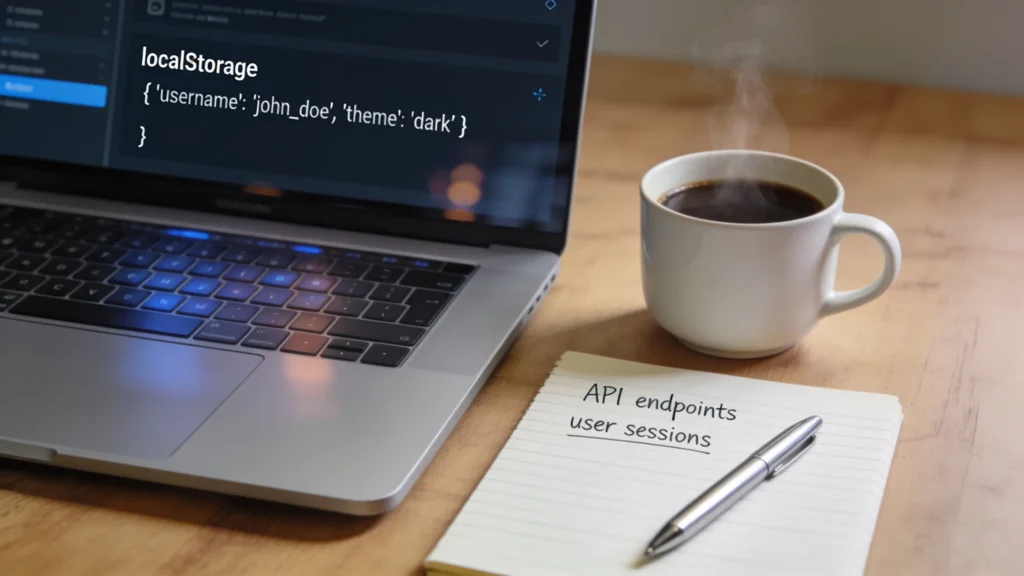
localStorage is a part of the Web Storage API, providing a way to store key-value pairs in a web browser. This storage is persistent, meaning that the data remains available even after the browser is closed and reopened. Unlike cookies, which are sent to the server with every HTTP request, data stored in localStorage is kept on the client side, leading to improved performance and reduced server load.
One of the key advantages of localStorage is its simplicity. You can easily store strings, and since it has a synchronous API, it’s straightforward to use within your JavaScript code. The capacity of localStorage varies by browser but is generally around 5 to 10 MB, which is significantly more than what cookies can hold.
Additionally, localStorage offers a straightforward interface. The data stored is accessible only within the same origin, which includes the protocol, hostname, and port. This means that you can’t read localStorage data from a different domain, enhancing security.
To utilize localStorage, you can interact with it through the global window.localStorage object. Here’s a simple example of how to set an item:
localStorage.setItem('username', 'ScottMeyers');
In this case, we’re storing a username. Retrieving it is just as easy:
const username = localStorage.getItem('username');
console.log(username); // Output: ScottMeyers
It’s essential to remember that localStorage can only store strings. If you want to save objects or arrays, you need to serialize them into a JSON string first. This is where the JSON object comes into play. You can convert an object to a string like this:
const user = { name: 'Scott', age: 45 };
localStorage.setItem('user', JSON.stringify(user));
To retrieve and parse this data back into an object, you would do the following:
const userData = JSON.parse(localStorage.getItem('user'));
console.log(userData.name); // Output: Scott
Understanding these capabilities allows you to efficiently manage client-side data storage, but it’s also crucial to consider the implications of using localStorage. Data stored in localStorage can be vulnerable to cross-site scripting (XSS) attacks, so always validate and sanitize any input that may end up being stored. Moreover, localStorage is synchronous, which means it can block the main thread, potentially leading to performance issues if misused.
In scenarios where you need to handle large amounts of data or require more sophisticated data management features, alternatives such as IndexedDB may be more suitable. However, localStorage remains a solid choice for straightforward key-value storage needs, especially when simplicity and ease of use are priorities.

The North Face Women's Jester Everyday Laptop Backpack - Commuter Travel Bag, Laptop Sleeve, Water-Repellent, TNF Black-NPF, One Size
$85.50 (as of July 19, 2026 03:41 GMT +00:00 - More infoProduct prices and availability are accurate as of the date/time indicated and are subject to change. Any price and availability information displayed on [relevant Amazon Site(s), as applicable] at the time of purchase will apply to the purchase of this product.)Retrieving data with getItem method
Retrieving data from localStorage is primarily done using the getItem method. This method takes a single argument: the key of the item you want to retrieve. If the key exists, it returns the corresponding value as a string. If the key does not exist, it returns null. Understanding this behavior is important because it influences how you handle the retrieved data.
Here’s a typical usage pattern for getItem:
const storedValue = localStorage.getItem('someKey');
if (storedValue !== null) {
  console.log('Value found:', storedValue);
} else {
  console.log('No value found for key "someKey"');
}
Notice that you always need to check for null before using the retrieved value. Failing to do so can lead to bugs, especially if you try to parse or manipulate the value assuming it exists.
Also, keep in mind that the value returned is always a string. Even if you stored a number or a boolean as a string, it will be retrieved as a string. For example:
localStorage.setItem('age', '30');

const age = localStorage.getItem('age');
console.log(typeof age); // "string"
console.log(age);        // "30"
If you want to use this value as a number, you must explicitly convert it:
const ageNumber = Number(localStorage.getItem('age'));
console.log(typeof ageNumber); // "number"
console.log(ageNumber);        // 30
Failing to convert can cause subtle bugs, especially in comparisons or calculations.
When working with complex data types like objects or arrays, the retrieved value will be a JSON string. This means you need to parse it back into its original form using JSON.parse. However, this introduces another potential failure point: if the stored string is not valid JSON, JSON.parse will throw an error.
To safely parse JSON retrieved from localStorage, you can use a try-catch block:
function safeGetItem(key) {
  const value = localStorage.getItem(key);
  if (value === null) {
    return null;
  }
  try {
    return JSON.parse(value);
  } catch (e) {
    console.warn('Failed to parse JSON for key', key, e);
    return null;
  }
}

const user = safeGetItem('user');
if (user !== null) {
  console.log(user.name);
} else {
  console.log('User data is not available or corrupted');
}
This approach prevents your application from crashing due to malformed data and provides an opportunity to handle errors gracefully.
Another common pattern involves providing a default value if the key is missing or the data is invalid. For instance:
function getUser() {
  const userData = safeGetItem('user');
  return userData || { name: 'Guest', age: 0 };
}

const currentUser = getUser();
console.log(currentUser.name);
Remember that localStorage keys and values are case-sensitive. Attempting to retrieve a value using a different casing than what was used to store it will return null. This can be a source of elusive bugs, so consistency in key naming is essential.
Since localStorage is synchronous, calling getItem multiple times in quick succession is generally inexpensive for small data sizes, but it can become a bottleneck if you access it repeatedly in performance-critical parts of your application. Caching the retrieved data in a variable after the first call can alleviate this:
const cachedUser = safeGetItem('user');
// Use cachedUser throughout the code instead of multiple getItem calls
In summary, getItem is simple but requires careful handling of its return values. Always check for null, handle data type conversions explicitly, and prepare for JSON parsing errors. These practices ensure that your code remains robust and less prone to runtime errors when interacting with localStorage.
Handling data types and parsing JSON
Because localStorage stores only strings, managing data types beyond strings requires explicit conversion. For primitive types like numbers or booleans, you must serialize and deserialize manually or use built-in functions such as Number(), Boolean(), or JSON.parse(). However, JSON is the most versatile tool when dealing with structured data like objects and arrays.
When storing complex data, the usual pattern is to convert the object into a JSON string before saving it:
const settings = {
  theme: 'dark',
  notificationsEnabled: true,
  volume: 75
};

localStorage.setItem('settings', JSON.stringify(settings));
Retrieving this data requires parsing the JSON string back to an object. But since the data could be missing or corrupted, a robust approach is necessary:
function getSettings() {
  const raw = localStorage.getItem('settings');
  if (raw === null) {
    return null; // or return a default settings object
  }
  try {
    return JSON.parse(raw);
  } catch (error) {
    console.error('Error parsing settings:', error);
    return null; // or fallback to defaults
  }
}

const userSettings = getSettings();
if (userSettings) {
  console.log(userSettings.theme);
}
One subtlety to watch for is that JSON does not preserve functions, undefined, or special object types like Date or Map. Attempting to store those will lose semantics or result in data loss. For example, dates become strings:
const event = {
  name: 'Meeting',
  date: new Date()
};

localStorage.setItem('event', JSON.stringify(event));

const storedEvent = JSON.parse(localStorage.getItem('event'));
console.log(typeof storedEvent.date); // "string", not a Date object
To handle dates properly, you need to manually convert them back:
storedEvent.date = new Date(storedEvent.date);
console.log(storedEvent.date instanceof Date); // true
Similarly, if you need to store special data types or functions, consider using a custom serialization strategy or alternative storage methods.
Another common pitfall is forgetting that JSON.parse can throw if the stored string isn’t valid JSON. This can happen if the data was manually edited, corrupted, or if a non-JSON string was stored by mistake. Always use try-catch when parsing data from localStorage or implement a safe parsing wrapper:
function safeParse(jsonString) {
  try {
    return JSON.parse(jsonString);
  } catch {
    return null;
  }
}

const data = safeParse(localStorage.getItem('dataKey'));
if (data) {
  // Use data safely
}
This prevents runtime exceptions and keeps your application stable when encountering unexpected or malformed data.
For simple flags or numeric values, storing them as strings and converting on retrieval is sufficient:
localStorage.setItem('isLoggedIn', 'true');

const isLoggedIn = localStorage.getItem('isLoggedIn') === 'true';
console.log(isLoggedIn); // true
Or for numbers:
localStorage.setItem('highScore', '1500');

const highScore = parseInt(localStorage.getItem('highScore'), 10);
if (!isNaN(highScore)) {
  console.log('High score:', highScore);
}
Always validate the parsed values before use to avoid unexpected behavior.
Finally, when you need to clear or reset stored data, remember that localStorage does not provide a way to selectively remove parts of a stored JSON object. You must retrieve, modify, and then re-save the entire object:
const profile = JSON.parse(localStorage.getItem('profile')) || {};
delete profile.lastLogin;

localStorage.setItem('profile', JSON.stringify(profile));
This read-modify-write pattern is common and necessary due to the string-only nature of localStorage.