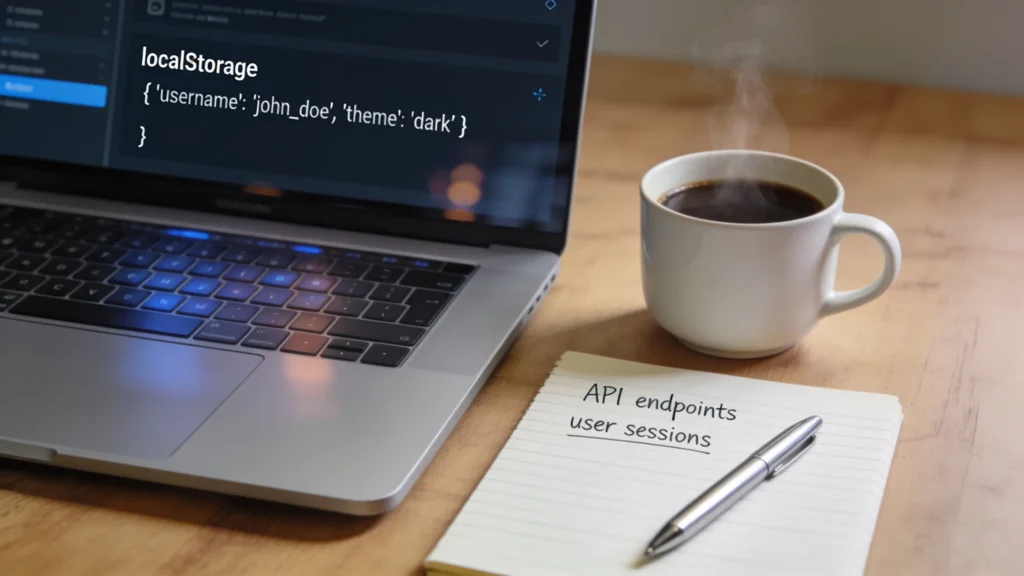
localStorage is a powerful feature of the Web Storage API that allows you to store key-value pairs in the browser. Unlike cookies, data stored in localStorage is persistent across browser sessions, meaning it won’t be deleted when the user closes the browser. This can be incredibly useful for applications that require user preferences or temporary data storage.
The primary benefit of using localStorage is its simplicity. It provides a straightforward way to save data without the complexities of server-side storage. Additionally, localStorage has a significant advantage in terms of speed; since the data is stored locally, it can be accessed faster than making network requests.
Another advantage is its capacity. localStorage can typically hold around 5-10 MB of data per origin, which is considerably more than what cookies can handle. This makes it ideal for storing larger amounts of data, such as user settings or application state, without worrying about space limitations.
Here’s a simple example of how you might set a value in localStorage:
localStorage.setItem('theme', 'dark');
And to retrieve that value later, you can use:
const theme = localStorage.getItem('theme');
console.log(theme); // Output: dark
Keep in mind that localStorage is synchronous, which means that it can block the main thread if you’re working with large datasets. This could lead to performance issues in your application. It’s crucial to use it wisely and only when you need persistent storage.
One of the interesting aspects of localStorage is its accessibility. Since it’s tied to the origin (combination of protocol, host, and port), data stored by one site cannot be accessed by another. This means that you can store sensitive information without the worry of cross-origin data leaks, but it also means you need to manage your own security practices.
When it comes to clearing localStorage, you have a couple of options. You can remove individual items:
localStorage.removeItem('theme');
Or clear everything at once:
localStorage.clear();
This is particularly useful during development, as you might want to reset the storage state frequently. However, be cautious when deploying applications; clearing localStorage removes all data for that origin, which could disrupt user experience.
Understanding the limitations and possibilities of localStorage can greatly enhance your web applications. For instance, it’s not suitable for storing sensitive data, like passwords or personal information, because the stored data can be accessed via JavaScript. If you need a secure storage solution, consider using encryption before saving sensitive information.
Moving on to getting started with localStorage in your JavaScript code, you’ll find that the API is incredibly intuitive. It consists of just a few methods which are easy to remember, making implementation a breeze. Here’s a quick overview:
localStorage.setItem(key, value); // Store data
localStorage.getItem(key); // Retrieve data
localStorage.removeItem(key); // Remove a specific item
localStorage.clear(); // Clear all items
By leveraging these methods, you can efficiently manage the stored data as needed. It’s worth noting that localStorage stores everything as strings. If you’re dealing with objects, you’ll need to serialize them using JSON:
const user = { name: 'Alice', age: 30 };
localStorage.setItem('user', JSON.stringify(user));
And when retrieving, you’d parse it back to an object:
const userData = JSON.parse(localStorage.getItem('user'));
console.log(userData.name); // Output: Alice
These simple steps allow you to maintain state and provide a more personalized experience for your users. But remember, while localStorage is convenient, it’s important to consider the overall architecture of your application and how localStorage fits into it.

Oura Ring 4 Sizing Kit - Smart Ring Accessory - Before You Buy - Unique Sizing, Not Standard US Sizes - Receive Credit for Purchase - Compatible with Oura App, Android & iOS
$8.49 (as of July 19, 2026 03:41 GMT +00:00 - More infoProduct prices and availability are accurate as of the date/time indicated and are subject to change. Any price and availability information displayed on [relevant Amazon Site(s), as applicable] at the time of purchase will apply to the purchase of this product.)Getting started with localStorage in your JavaScript code
A crucial first step before you rely on localStorage is to verify that the browser actually supports it and has it enabled. While support is nearly universal in modern browsers, you can’t assume it’s always available. A user might be in a private browsing mode that restricts storage, or using an older browser, or have it disabled through settings. Simply calling localStorage.setItem() without checking will throw an error and halt your script execution, which is a terrible failure mode.
The standard way to check for support is to wrap a test operation in a try...catch block. This function attempts to write, read, and remove a test item. If any of these operations fail, it catches the exception and returns false.
function isLocalStorageAvailable() {
  let storage;
  try {
    storage = window.localStorage;
    const x = '__storage_test__';
    storage.setItem(x, x);
    storage.removeItem(x);
    return true;
  } catch (e) {
    return e instanceof DOMException && (
      // everything except Firefox
      e.code === 22 ||
      // Firefox
      e.code === 1014 ||
      // test name field too, because code might not be present
      // everything except Firefox
      e.name === 'QuotaExceededError' ||
      // Firefox
      e.name === 'NS_ERROR_DOM_QUOTA_REACHED') &&
      // acknowledge QuotaExceededError only if there's something already stored
      (storage && storage.length !== 0);
  }
}

if (isLocalStorageAvailable()) {
  // All systems go! You can use localStorage.
  console.log('localStorage is available.');
} else {
  // Fallback or notify the user.
  console.log('localStorage is not available.');
}
Once you’ve confirmed that localStorage is ready for use, you can build features with it. A classic example is persisting a user’s choice of a light or dark theme. This is a perfect use case: it’s a simple preference that should be remembered across sessions but doesn’t require server-side storage.
Let’s assume you have some CSS that applies a dark theme when a dark-mode class is present on the tag. Your goal is to save the user’s choice so that the next time they visit, the page loads directly with the correct theme, avoiding a jarring flash of the default theme before your script runs.
// Function to apply the theme by toggling a class on the body
function applyTheme(theme) {
  document.body.classList.toggle('dark-mode', theme === 'dark');
}

// 1. On page load, immediately check for a saved theme
document.addEventListener('DOMContentLoaded', () => {
  const savedTheme = localStorage.getItem('theme') || 'light'; // Default to 'light' if nothing is saved
  applyTheme(savedTheme);

  // 2. Set up the button to toggle and save the theme
  const themeToggleButton = document.getElementById('theme-toggle');
  if (themeToggleButton) {
    themeToggleButton.addEventListener('click', () => {
      // Check the current state from the DOM or a variable
      const isDarkMode = document.body.classList.contains('dark-mode');
      const newTheme = isDarkMode ? 'light' : 'dark';

      localStorage.setItem('theme', newTheme);
      applyTheme(newTheme);
    });
  }
});
This code is organized into two main parts. The first part runs as soon as the DOM is ready. It queries localStorage for a key named theme. If a value is found, it’s used to apply the theme. If not, it defaults to ‘light’. This initial check is what ensures a consistent experience between visits. The second part sets up the event listener for the toggle button. When clicked, it determines what the new theme should be, saves that choice to localStorage with setItem(), and then updates the page by calling our applyTheme function. The key is that the UI state (the CSS class) and the stored state are always kept in sync. This simple pattern is incredibly powerful for managing user preferences without any backend code.
Storing and retrieving data with localStorage
Best practices for using localStorage effectively revolve around understanding its limitations and optimizing its usage to enhance user experience. One of the most critical aspects is to limit the amount of data you store. While localStorage can handle a few megabytes of data, it’s still best to keep it minimal and only store what is necessary. This helps prevent performance issues and ensures that you stay within the storage limits imposed by the browser.
Another essential practice is to use meaningful keys for your stored items. Instead of generic names like item1 or data, opt for descriptive keys that clearly indicate the purpose of the data. This makes it easier to manage and debug your localStorage entries later on. For example:
localStorage.setItem('userPreferences', JSON.stringify(preferences));
In this case, userPreferences is much more informative than simply calling it pref. This clarity becomes invaluable as your application grows and you accumulate more data.
Moreover, be cautious about the data types you store. Since localStorage only supports strings, you need to serialize complex data structures like arrays and objects. However, remember that this adds overhead. If you find yourself frequently serializing and deserializing data, consider whether localStorage is the right tool for the job, or if another solution might be more appropriate.
When dealing with multiple data entries, it’s wise to group related data under a single key, rather than creating separate entries for each one. This can reduce the number of calls to localStorage and simplify your retrieval process. For example, instead of storing user settings individually:
localStorage.setItem('theme', 'dark');
localStorage.setItem('fontSize', '16px');
localStorage.setItem('language', 'en');
Consider storing them as a single object:
const userSettings = {
  theme: 'dark',
  fontSize: '16px',
  language: 'en'
};
localStorage.setItem('userSettings', JSON.stringify(userSettings));
Retrieving this grouped data is straightforward:
const settings = JSON.parse(localStorage.getItem('userSettings'));
console.log(settings.theme); // Output: dark
In addition, implementing a versioning system for your stored data can help manage changes over time. If your application evolves and the structure of your stored data changes, you can use a version number to ensure backward compatibility. This way, you can check the version of the data when retrieving it and apply any necessary migrations:
const userData = JSON.parse(localStorage.getItem('userData'));
if (userData.version < 2) {
  // Migrate userData to the new structure
}
Finally, don’t forget to implement a cleanup strategy for your localStorage. Regularly review and remove data that is no longer needed. This not only helps free up space but also keeps your data organized. You can set a time limit for certain entries or provide users with the ability to clear their preferences through the UI.
By following these best practices, you can ensure that your use of localStorage is efficient, organized, and user-friendly. This will ultimately lead to a better experience for your users, as they can rely on your application to remember their preferences without unnecessary clutter or confusion. As you build more complex applications, keeping these principles in mind will help you maintain a clean storage strategy. The more you refine your approach, the better your application will function, both in terms of performance and user satisfaction. Remember, localStorage is a tool, and like any tool, it’s only as effective as the way you choose to use it.
Best practices for using localStorage effectively
One of the most violated best practices is treating localStorage as a secure vault. It is not. Data in localStorage is accessible to any JavaScript code running on your page. This means if your site has a Cross-Site Scripting (XSS) vulnerability, an attacker can inject a script to steal all the data stored in localStorage. For this reason, you must never store sensitive information there. This includes session tokens, API keys, JSON Web Tokens (JWTs), personal user data, or anything you wouldn’t want plastered on a public billboard. The proper place for session identifiers is in a secure, HttpOnly cookie, which cannot be accessed by client-side scripts.
You also need to be defensive about writing data. The browser enforces a storage quota, typically around 5MB. If you try to save an item that exceeds the remaining space, the browser will throw a DOMException, often called a QuotaExceededError. If you don’t handle this, your script will crash. Every call to setItem() is a potential point of failure. Therefore, you should wrap your storage operations in a try...catch block to handle these errors gracefully, perhaps by notifying the user or attempting to clear out old, non-essential data.
function safeSetItem(key, value) {
  try {
    localStorage.setItem(key, value);
    return true;
  } catch (e) {
    if (e.name === 'QuotaExceededError') {
      console.error('Storage quota exceeded! Could not save item.');
      // Here you could implement a cleanup strategy
      // or inform the user they need to clear some space.
    } else {
      console.error('An error occurred while saving to localStorage:', e);
    }
    return false;
  }
}

// Usage
const largeObject = { data: new Array(1000000).join('a') };
safeSetItem('largeData', JSON.stringify(largeObject));
It’s also crucial to remember that localStorage is a synchronous API. This means when you call localStorage.getItem() or localStorage.setItem(), you are blocking the main browser thread. The browser has to stop everything-rendering updates, running animations, responding to user clicks-while it performs the read/write operation on the disk. For small key-value pairs, this is imperceptibly fast. But if you are storing and retrieving large JSON objects, this synchronous operation can cause noticeable UI freezes, or “jank.” If your application needs to store a significant amount of data client-side, you should use an asynchronous API like IndexedDB, which was designed for exactly that purpose and won’t block the user interface.
A good architectural pattern to adopt is to abstract away your interactions with localStorage. Instead of having calls to localStorage.setItem() and JSON.parse() scattered throughout your codebase, create a dedicated service or module. This abstraction layer can handle JSON serialization, error handling, and feature detection internally. This centralizes your storage logic, making your code cleaner, easier to test, and much simpler to maintain or even replace. If you decide to migrate from localStorage to IndexedDB later, you only have to update your storage service instead of hunting down every single usage in your application.
// A simple storage service abstraction
const storageService = {
  set(key, value) {
    try {
      const serializedValue = JSON.stringify(value);
      localStorage.setItem(key, serializedValue);
    } catch (e) {
      console.error(Error saving to localStorage for key "${key}":, e);
    }
  },
  get(key) {
    try {
      const serializedValue = localStorage.getItem(key);
      return serializedValue ? JSON.parse(serializedValue) : null;
    } catch (e) {
      console.error(Error reading from localStorage for key "${key}":, e);
      return null;
    }
  },
  remove(key) {
    localStorage.removeItem(key);
  }
};

// Now your application code is much cleaner
const userPrefs = { theme: 'dark', notifications: true };
storageService.set('userPrefs', userPrefs);
const loadedPrefs = storageService.get('userPrefs');
Finally, a powerful but often overlooked feature is the storage event. This event is fired on a window when a storage area (localStorage or sessionStorage) is changed in the context of another document from the same origin. In practical terms, if a user has your application open in two browser tabs and changes a setting in one, the storage event will fire in the other tab. This allows you to synchronize state across tabs. For example, if a user logs out in one tab, you can listen for the event in other tabs to automatically log them out there as well, providing a consistent user experience.
window.addEventListener('storage', (event) => {
  if (event.storageArea !== localStorage) return;

  if (event.key === 'sessionToken') {
    console.log('Session token changed in another tab.');
    // If the new value is null, it means the user logged out.
    if (event.newValue === null) {
      console.log('Logging out from this tab as well.');
      // Add logic here to redirect to the login page.
      window.location.href = '/login';
    }
  }
});